
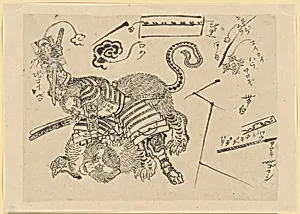
Yorimasa Killing Nue
18th–19th century
Medium
Ink on paper
Dimensions
6 7/8 x 9 3/8 in. (17.5 x 23.8 cm)
Classification
Paintings
Culture & Period
Japan · Edo period (1615–1868)
Department
Asian Art
Museum
Metropolitan Museum of Art, New York, NY
Credit
Gift of Annette Young, in memory of her brother, Innis Young, 1956
Accession Number
56.121.3
Rights
Public Domain
Tags
Art Historical Context
In the dynamic ink painting *Yorimasa Killing*, Katsushika Hokusai a thrilling moment from Japanese folklore. legendary warrior Minamoto no Yorim, a 12th-century hero, strikes down the monstrous Nue—a chimeric beast with a monkey's head, tanuki body, tiger's claws, and serpent tail that haunted the imperial court. Rendered in bold, fluid brushstrokes on paper, this 18th–19th-century work from Japan's Edo period (1615–1868) exemplifies Hokusai's mastery of ukiyo-e aesthetics, blending dramatic action with expressive minimalism. Hokusai, the iconic artist behind *The Great Wave off Kanagawa*, was renowned for his innovative use of ink to convey movement and emotion. Here, the intimate scale (just 6 7/8 x 9 3/8 inches) invites close viewing, highlighting the tension between man, sword, and beast—evident in the tags of swords, animals, and men. Created during the Edo era's cultural boom, when tales of yokai (supernatural creatures) captivated the public, this piece reflects Japan's rich tradition of narrative art. Now in the Metropolitan Museum of Art's Asian Art Department, gifted in 1956, it offers a window into Hokusai's versatility beyond prints, showcasing ink painting's precision and the enduring allure of samurai lore.
About the Artist
Katsushika Hokusai · 1760–1849
Katsushika Hokusai (1760-1849) stands as one of history's most influential artists, a Japanese master who revolutionized the ukiyo-e woodblock print tradition and profoundly shaped Western art. Born in the Katsushika district of Edo (modern-day Tokyo) to an artisan family, Hokusai lived through nearly nine decades of extraordinary creative evolution, adopting over thirty different artistic names t...