
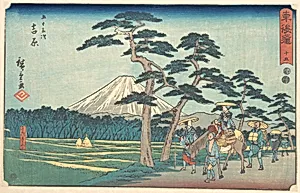
東海道五十三次 吉原 名所左り不二|Yoshiwara
ca. 1840
Medium
Woodblock print; ink and color on paper
Dimensions
Overall: 8 3/4 x 13 3/4in. (22.2 x 34.9cm)
Classification
Prints
Culture & Period
Japan · Edo period (1615–1868)
Department
Asian Art
Museum
Metropolitan Museum of Art, New York, NY
Credit
The Francis Lathrop Collection, Purchase, Frederick C. Hewitt Fund, 1911
Accession Number
JP765
Rights
Public Domain
Tags
Art Historical Context
Utagawa Hiroshige1797–1858), a master of ukiyo-e woodblock prints, captures the essence of travel and nature in *The Fifty-three Stations of theōkaidō: Yoshiwara (Meisho sari Fuji)*, created around 1840 during Japan's Edo period (1615–1868). This vibrant print is part of Hiroshige's iconic series depicting the bustling postal stations along the Tōkaidō road, the vital coastal route connecting Edo (modern Tokyo) to Kyoto. Yoshiwara, the fifth station from Edo, offered weary travelers a glimpse of the majestic Mount Fuji rising dramatically to the left—a celebrated "famous view" that Hiroshige renders with poetic precision. In this scene, men stride purposefully along the path, accompanied by horses amid lush trees and distant mountains, evoking the rhythm of Edo-era journeys undertaken by samurai, merchants, and pilgrims. Hiroshige's genius lies in his atmospheric use of color and line: subtle gradients of blue and green convey depth and mist, while bold outlines and layered inks on paper create a sense of movement and serenity. Woodblock printing, involving collaborative carving and printing by artisans, made such affordable art accessible to the masses, democratizing beauty. Culturally, the series romanticized travel amid Japan's isolationist sakoku policy, fueling wanderlust and influencing global art, from Whistler to Van Gogh. At the Metropolitan Museum of Art, this Francis Lathrop Collection gem invites visitors to step into a bygone era of exploration and artistry.
About the Artist
Utagawa Hiroshige · 1826–1869
Utagawa Hiroshige (1797–1858), born Andō Tokutarō, was the last great master of Japanese ukiyo-e woodblock printmaking and one of the most influential landscape artists in history. Born in Edo (modern Tokyo) into a low-ranking samurai family serving as fire wardens, Hiroshige transformed landscape printmaking into a poetic meditation on nature, weather, and everyday life. His revolutionary approac...