
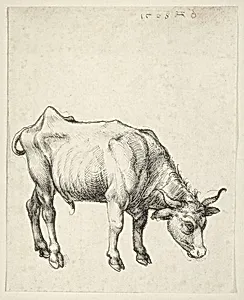
Young Bull
c. 1496, erroneously inscribed in another hand 1508
Medium
Pen and black ink on ivory laid paper
Dimensions
17.5 × 14 cm (6 15/16 × 5 9/16 in.)
Classification
pen and ink drawings
Department
Prints and Drawings
Museum
Art Institute of Chicago
Accession Number
23506
Rights
Public Domain
About this artwork
From an early age, Albrecht Dürer displayed an inquisitive mind and exceptional talent as a draftsman. He was born in Nuremberg and first trained as a goldsmith in his father’s shop before apprenticing with the painter Michael Wolgemut. One of his earliest animal drawings, Young Steer shows its subject grazing in an unseen field. The artist’s sure strokes and adept cross-hatching delineate the steer’s sculptural form, with taut skin stretched over a strong yet bony frame. Dürer’s precise draftsm...
Art Historical Context
Albrecht Dürer's *Young Bull*, created around 1496, exemplifies the artist's early mastery of naturalistic observation during his formative years in Nuremberg. At just 25, Dürer was already traveling through Europe, honing his skills in capturing the living world with unprecedented precision. This pen and black ink drawing on ivory laid paper measures a modest 17.5 × 14 cm, yet its intimate scale invites close inspection, revealing the bull's textured hide, alert posture, and muscular form rendered with fluid, economical lines. Dürer's Northern Renaissance style shines here through his meticulous technique, blending German precision with Italian influences from his recent journeys. The drawing likely served as a study from life, a practice central to his innovative approach that bridged art and science—foreshadowing masterpieces like his famous *Young Hare* (1502). Notably, a later hand erroneously inscribed "1508" on the sheet, a common occurrence with such works that underscores their enduring value. Housed in the Art Institute of Chicago's Prints and Drawings Department, *Young Bull* highlights Dürer's role in elevating drawing from preparatory sketch to autonomous artwork, influencing generations of artists in their pursuit of realism and detail.
About the Artist
Albrecht Dürer · 1471–1528
Albrecht Dürer (1471–1528) stands as the preeminent figure of the Northern Renaissance and arguably the most influential artist in the history of printmaking. Born in Nuremberg on May 21, 1471, and dying in the same city on April 6, 1528, Dürer revolutionized the status of the artist in Northern Europe, transforming printmaking from a commercial craft into an independent fine art and establishing ...