
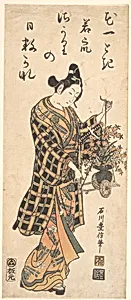
石川豊信画 小型花車持ち若衆|Young Man (Wakashu) with a Miniature Flower Cart
ca. 1750–60s
Medium
Woodblock print; ink and color on paper
Dimensions
H. 14 1/4 in. (36.2 cm); W. 6 in. (15.2 cm)
Classification
Prints
Culture & Period
Japan · Edo period (1615–1868)
Department
Asian Art
Museum
Metropolitan Museum of Art, New York, NY
Credit
H. O. Havemeyer Collection, Bequest of Mrs. H. O. Havemeyer, 1929
Accession Number
JP1613
Rights
Public Domain
Tags
Art Historical Context
In the vibrant world of Edo-period Japan (1615–1868), Ishikawa Toyonobu (1711–1785), a master of ukiyo-e—"pictures of the floating world"—captured the allure of urban life. This charming woodblock print from around 1750–60 depicts a *wakashu*, a youthful male figure central to kabuki theater and popular culture. With his distinctive piled hairstyle, flowing robes, and a playful miniature flower cart, the young man embodies the androgynous beauty admired in 18th-century Edo society, where such figures symbolized transient pleasures and romantic ideals. Toyonobu's hosoban format—narrow at just 6 inches wide—made these prints affordable and intimate, perfect for personal collections or album leaves. Printed with ink and vibrant colors from multiple woodblocks, the technique allowed precise layering of hues, from delicate pinks in the flowers to rich textures in the fabrics, showcasing ukiyo-e's technical innovation. Part of the celebrated H.O. Havemeyer Collection at The Metropolitan Museum of Art, this work highlights the genre's role in democratizing art, bringing theater-inspired elegance to everyday viewers. (198 words)
About the Artist
Ishikawa Toyonobu · 1711–1785
Japanese, 1711–1785