
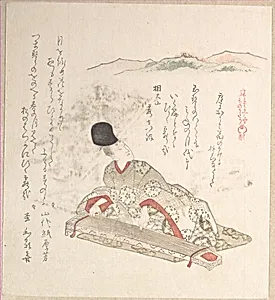
Young Nobleman Playing Koto (Harp)
19th century
Medium
Woodblock print (surimono); ink and color on paper
Dimensions
7 15/16 x 7 3/16 in. (20.2 x 18.3 cm)
Classification
Prints
Culture & Period
Japan · Edo period (1615–1868)
Department
Asian Art
Museum
Metropolitan Museum of Art, New York, NY
Credit
H. O. Havemeyer Collection, Bequest of Mrs. H. O. Havemeyer, 1929
Accession Number
JP1989
Rights
Public Domain
Tags
Art Historical Context
In the serene world of Edo-period Japan (1615–8), Kubo Shunman captures a moment of refined elegance in *Young Nobleman Playing KotoHarp)*, a exquisite surimono woodblock print the 19th century. Shunman, a master of ukiyo-e, specialized in these luxurious, privately commissioned prints, often created for poetry gatherings or New Year's celebrations. Measuring just 7 15/16 x 7 3/16 inches, this intimate ink and color on paper work depicts a youthful nobleman gracefully strumming the koto—a traditional zither-like instrument symbolizing courtly sophistication and artistic cultivation among Japan's elite samurai and literati classes. Surimono like this one showcase advanced woodblock techniques, with vibrant colors, fine linework, and subtle gradients (bokashi) that evoke depth and atmosphere. The nobleman's poised figure against a mountainous backdrop highlights themes of harmony with nature, a staple in Japanese art. The koto's resonant strings not only fill the scene with melody but also nod to Heian-era court traditions revived in Edo culture, blending music, poetry, and visual beauty. Part of the renowned H. O. Havemeyer Collection at the Metropolitan Museum of Art, this print offers a window into Japan's floating world (ukiyo), where everyday refinement met artistic innovation, inviting visitors to ponder the nobleman's quiet virtuosity.
About the Artist
Kubo Shunman · 1757–1820
Japanese, 1757–1820