
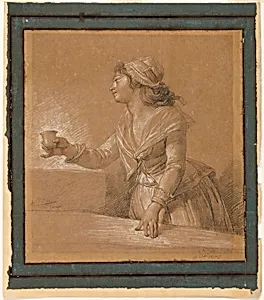
Young Woman at a Table Holding a Cup
Medium
Black and white chalks, with touches of red chalk, on tan laid paper, laid down on cream wove paper, with margins in blue laid paper and pen and iron gall ink
Dimensions
Primary support: 46.2 × 44 cm (18 1/4 × 17 3/8 in.); Secondary support: 58.8 × 51.2 cm (23 3/16 × 20 3/16 in.)
Classification
chalk
Department
Prints and Drawings
Museum
Art Institute of Chicago
Accession Number
149541
Rights
Public Domain
About this artwork
When François-André Vincent made this endearing portrait of Marie-Gabrielle Capet in 1790, he had just been appointed professor at the Royal Academy and curator of the king’s drawings collection. Capet came from Lyons to Paris to study with Vincent’s life-long companion, the portraitist and miniaturist Adélaïde Labille-Guiard. Capet became her favorite pupil, then their housemate and model, and ultimately their caretaker in old age. The artist’s use of three chalks and deliberate grace reflects ...
Art Historical Context
François-Andre Vincent’s *Young Woman at a Table Holding a Cup* (1790) offers an intimate glimpse into late-eighteenth-century French draftsmanship. Created just before the height of the French Revolution, the drawing reflects the refined neoclassical taste that Vincent helped shape alongside contemporaries such as Jacques-Louis David. Although best known for large history paintings, Vincent was also admired for his sensitive portraits and figure studies executed in chalk. The work demonstrates the expressive possibilities of the medium: black and white chalks, accented with touches of red, are applied to tan laid paper to model soft shadows and luminous highlights across the woman’s face and hands. This technique, sometimes called *trois crayons*, allows for both precise contour and velvety tonal gradation, giving the figure a lifelike warmth. The sheet’s elaborate presentation—laid onto a secondary support and bordered with blue paper and pen-and-ink margins—indicates it was valued as a finished work of art rather than a preparatory sketch. Today housed in the Art Institute of Chicago’s Prints and Drawings collection, the drawing invites viewers to appreciate the quiet dignity of everyday gesture rendered with exceptional technical finesse. Its modest scale (roughly eighteen by seventeen inches) encourages close looking, revealing Vincent’s mastery of light and texture in a moment captured on the eve of profound historical change.