
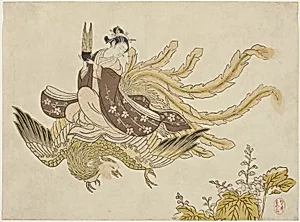
Young Woman Riding a Phoenix
1765
Medium
Color woodblock print; chuban yoko-e
Dimensions
20.5 × 27.7 cm (8 × 10 7/8 in.)
Classification
woodblock print
Department
Arts of Asia
Museum
Art Institute of Chicago
Accession Number
44206
Rights
Public Domain
About this artwork
Here, a beautiful young woman riding on a phoenix holds pan pipes (sho) in her hands. The numbers for the long months of the year are visible on her sleeve. This subject probably refers to a Chinese immortal. One possibility is the sage who was known for his enchanting flute playing, while another is the sage who was often pictured riding a phoenix.
Art Historical Context
Suzuki Harunobu's *Young Woman Riding a Phoenix* (1765) is a captivating color woodblock print from Japan's Edo period, exemplifying the ukiyo-e tradition of "pictures of the floating world." This chuban yoko-e—a horizontal format measuring just 20.5 × 27.7 cm—captures a graceful young woman astride a majestic phoenix, blending earthly beauty with mythical elegance. Harunobu (1718–1770), a master of bijin-ga (images of beautiful women), pioneered full-color nishiki-e prints in 1765, using multiple woodblocks to layer vibrant hues like soft pinks, blues, and golds, revolutionizing Japanese printmaking from monochromatic to richly polychromatic. The artwork's historical significance lies in its timing: produced in the year Harunobu introduced benizuri-e's colorful successor, it marked a shift toward accessible art for urban Edo audiences. The phoenix, a sacred bird symbolizing rebirth and imperial virtue in East Asian lore, elevates the bijin (beauty) to a fantastical realm, reflecting ukiyo-e's playful fusion of reality and imagination. Housed in the Art Institute of Chicago's Arts of Asia department, this print invites visitors to appreciate Harunobu's delicate lines and subtle shading, techniques that influenced later masters like Hiroshige and Hokusai. A gem of 18th-century innovation, it whispers of fleeting beauty amid mythical splendor.
About the Artist
Suzuki Harunobu · 1725–1770
Suzuki Harunobu (c. 1725-1770) was a Japanese ukiyo-e artist who revolutionized woodblock printing by developing nishiki-e—full-color prints using multiple woodblocks—in 1765. Before Harunobu, Japanese prints were limited to two or three colors; his innovation unleashed the entire artist's palette, transforming ukiyo-e into the vibrant art form that would later captivate Western artists from Manet...