
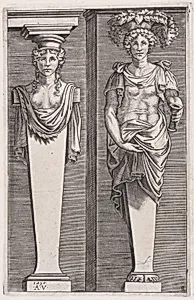
Young Women from "The Hermae"
dated 1536
Medium
Engraving
Dimensions
8 1/16 x 5 3/16 in. (20.5 x 13.2 cm)
Classification
Prints
Department
Drawings and Prints
Museum
Metropolitan Museum of Art, New York, NY
Credit
Harris Brisbane Dick Fund, 1926
Accession Number
26.50.1(61)
Rights
Public Domain
Art Historical Context
This engraving, created in 1536 by Agostino Veneziano (also known as Agostino dei Musi), captures the refined elegance of Renaissance printmaking. As a leading Italian engraver of the period, Veneziano was renowned for his precise technique and ability to translate sculptural or painted forms into intricate linear compositions. The work belongs to his series titled “The Hermae,” which likely draws inspiration from classical herms—ancient pillars topped with heads or figures—reimagined here as graceful young women. Engravings such as this played a vital role in the 16th century by making art widely accessible beyond the walls of palaces and churches. Through the meticulous incising of copper plates, artists like Veneziano could produce multiple impressions, allowing motifs from antiquity and contemporary design to circulate across Europe. The compact scale of the sheet—roughly the size of a small book page—further suggests it was intended for intimate viewing or inclusion in collectors’ albums. Today housed in the Metropolitan Museum of Art’s Department of Drawings and Prints, this piece exemplifies the enduring appeal of Renaissance graphic art. Its crisp lines and balanced composition invite viewers to appreciate both the technical mastery of engraving and the period’s fascination with classical ideals of beauty and proportion.