
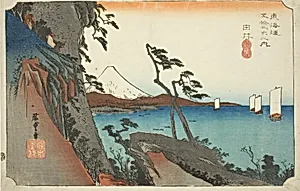
Yui: Satta Peak (Yui, Satta mine), from the series "Fifty-three Stations of the Tokaido Road (Tokaido gojusan tsugi no uchi)," also known as the Hoeido Tokaido
c. 1833/34
Medium
Color woodblock print; oban
Dimensions
23.7 × 37 cm (9 5/16 × 14 9/16 in.)
Classification
woodblock print
Department
Arts of Asia
Museum
Art Institute of Chicago
Accession Number
18255
Rights
Public Domain
Art Historical Context
Utagawa Hiroshige's *Yui: Satta Peak (Yui, Satta mine)* is a captivating color woodblock print from his series *Fifty-three Stations the Tokaido RoadTokaido gojusan tsugi no uchi)*, also known as theido Tokaido, created around 1833–34. This series immortalizes the 53 post stations along the historic Tokaido route connecting Edo (modern Tokyo) to Kyoto, a vital artery for travelers, pilgrims, and officials during Edo period (1603–1868). Hiroshige, a master of the ukiyo-e ("pictures of the floating world") school, elevated landscape prints with his poetic sensitivity to nature, weather, and human activity, making this the most famous of several Tokaido editions. Depicting the Yui station overlooked by the dramatic Satta Peak, the oban-sized print (23.7 × 37 cm) showcases Hiroshige's innovative use of color woodblock techniques. Multiple carved woodblocks were inked in vibrant hues—bold blues for the sea, earthy tones for the cliffs—and precisely registered to create depth and atmosphere. Travelers ascending the steep path evoke the arduous yet scenic journey, blending realism with evocative mood. Housed in the Art Institute of Chicago's Arts of Asia department, this print highlights ukiyo-e's cultural role in democratizing art for everyday viewers. Its enduring appeal influenced Western artists like Van Gogh, bridging Japanese printmaking traditions with global art history.
About the Artist
Utagawa Hiroshige · 1826–1869
Utagawa Hiroshige (1797–1858), born Andō Tokutarō, was the last great master of Japanese ukiyo-e woodblock printmaking and one of the most influential landscape artists in history. Born in Edo (modern Tokyo) into a low-ranking samurai family serving as fire wardens, Hiroshige transformed landscape printmaking into a poetic meditation on nature, weather, and everyday life. His revolutionary approac...