
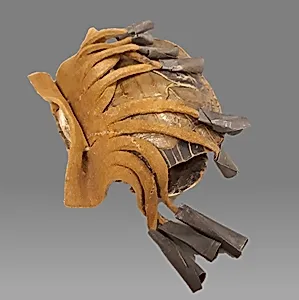
Yung-Wey-Sha-Na (rattle)
Unknown Artist
19th century
Medium
turtle, buckskin, tin
Dimensions
shell: L. ±3 3/4 × W. ±3 1/8 in. (9.5 × 8 cm) fringe L. ±2 15/16 in. (7.5 cm)
Classification
Idiophone-Shaken-rattle
Culture
Native American (Hopi)
Department
Musical Instruments
Museum
Metropolitan Museum of Art, New York, NY
Credit
The Crosby Brown Collection of Musical Instruments, 1889
Accession Number
89.4.619
Rights
Public Domain
Art Historical Context
Welcome to the enchanting world of Hopi musical traditions at the Metropolitan Museum of Art The *Yung-Wey-Sha-Na*, a 19th-century rattle from the Native American Hopi culture, the ingenuity of indigenous craftsmanship. Classified as an idiophone—a self-sounding instrument—this compact rattle measures just about 3¾ inches long and 3⅛ inches wide for its turtle shell body, with a 2⅞-inch buckskin fringe. Crafted by an unknown Hopi artist, it was part of sacred rituals, dances, and ceremonies where its rhythmic shake produced evocative sounds to accompany storytelling, prayers, or communal gatherings. The rattle's materials tell a story of harmony with nature: a turtle carapace forms the resonant shell, symbolizing longevity and the earth's rhythms in Hopi cosmology; soft buckskin creates flowing fringe for visual flair during movement; and tinkling tin elements amplify the shake into a shimmering cascade of sound. This combination of organic and introduced materials reflects 19th-century Hopi innovation amid cultural exchanges. Acquired through The Crosby Brown Collection of Musical Instruments in 1889, this piece offers a window into pre-reservation Hopi life, preserving the tactile pulse of their vibrant sonic heritage for visitors today. Handle with care in your imagination—its gentle jingle still echoes ancestral voices!