
Zeden en Gewoonten der Turken
Medium
paper
Dimensions
474; 297
Rights
Public Domain
About this artwork
verzamelaarsmerk, verso rechtsonder, gestempeld: Lugt 240
Art Historical Context
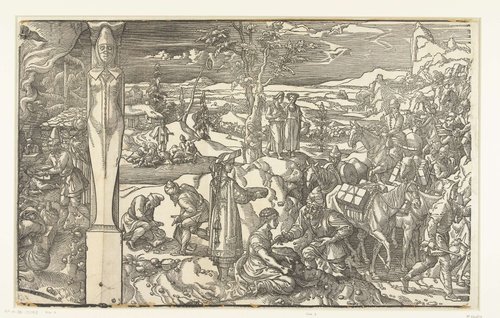
**Zeden en Gewoonten der Turken (Manners and Customs of Turks)** Pieter Coecke van Ast (I), a Flemish artist of the Northern Renaissance (1502–1550), created this work in 1553, after his death, as part of a celebrated series of prints. Measuring 297 × 474 mm on paper, it captures the daily life, attire, and rituals of Ottoman Turks, drawing from Coecke's firsthand observations during 1533 journey to (modern Istanbul). These detailed depictions were among the earliest visual ethnographies of the Islamic world available to European audiences, blending artistic skill with cultural curiosity. In the 16th century, Europe was gripped by fascination—and apprehension—toward the expanding Ottoman Empire, following the 1453 fall of Constantinople. Coecke's prints, likely woodcuts or engravings, served as an informative bridge, influencing tapestry designs and broader artistic representations of the "exotic" East. His style reflects Renaissance precision in costume and architecture, making complex scenes accessible and educational. A collector's mark (Lugt 240) stamped on the verso lower right attests to its prized status among connoisseurs, highlighting its enduring historical value as both art and artifact. This piece invites visitors to ponder the interplay of cultures in an era of discovery.