
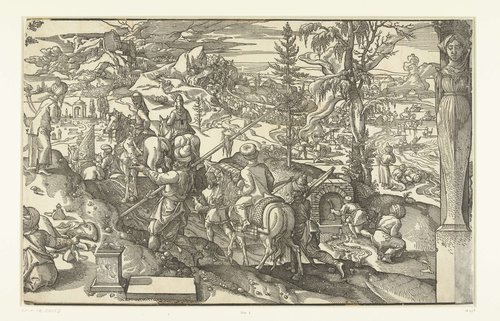
Zeden en Gewoonten der Turken
Medium
paper
Dimensions
290; 460
Rights
Public Domain
About this artwork
collector's mark: Lugt 240
Art Historical Context
**Zeden en Gewoont der Turken** (*Manners and Customs of the*), created by Flemish artist Pieter Coecke vanelst (I) in 1553, offers a fascinating window into 16th-century perceptions of the Ottoman world. Coecke van Aelst, a renowned designer of tapestries and prints active during the Renaissance, drew from his own travels to Constantinople (modern-day Istanbul) nearly two decades earlier. This paper-based work, measuring 290 mm high by 460 mm wide, likely captures daily Turkish life, rituals, or attire through detailed illustration—a medium that allowed for widespread dissemination of exotic imagery across Europe. Printed on paper, the piece exemplifies the woodcut or engraving techniques popular in the Northern Renaissance, enabling precise replication of intricate scenes for books and broadsheets. Coecke van Aelst's designs bridged art and ethnography, fueling Europe's growing curiosity about the Ottoman Empire amid tensions like the Habsburg-Ottoman wars. These prints not only educated but also shaped Western stereotypes and admiration for Eastern splendor. Bearing the collector's mark Lugt 240, this artwork underscores its value in historic collections, preserving a snapshot of cultural exchange in an era of discovery. Visitors, imagine holding a key to 1553's global imagination!