
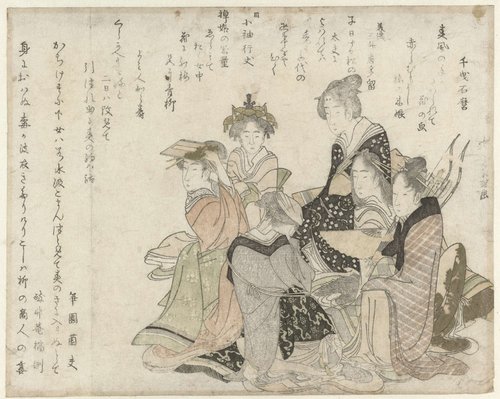
Zes vrouwen als de zes klassieke dichters
Medium
nishikie, with metallic pigments and blindprinting
Dimensions
232; 184
Rights
Public Domain
About this artwork
Een surimono is een luxe uitgevoerde prent waarop beeld met één of meerdere gedichten gecombineerd is. Bij het drukken van een surimono werd vaak gebruik gemaakt van dikker papier, blinddruk en metaal pigmenten, zoals koper- en zilverpoeder. De prenten werden vaak in opdracht van dichters gemaakt en als exclusief geschenk aan vrienden en relaties gegeven. Een egoyomi is een kalender prent, waarop de aanduiding voor de maanden verstopt zit in het ontwerp. Vaak werden egoyomi net als surimono in ...
Art Historical Context
In 1798, Katsushika Hai, the legendary ukiyo-e master still early in his prolific career, created *Zes vrouwen als zes klassieke dichters*Six Women as the Six Classical Poets"). This intimate woodblock print (nishikie) measures just 184 × 232 mm, depicting elegant women embodying Japan's revered poets—likely figures like Fujiwara no Teika or Saigyō—in a playful feminized tribute. Hokusai's fluid lines and vibrant composition capture the floating world (ukiyo-e) spirit, blending beauty with literary homage. Luxuriously crafted as a surimono, it pairs imagery with poetry on thick paper, enhanced by shimmering metallic pigments (like copper and silver powders) and tactile blindprinting for an exclusive, gift-like feel. It may also function as an egoyomi, a private calendar print hiding lunar month markers within the design—a clever workaround to government restrictions on official calendars until 1873. These self-published gems were shared among friends, evading rules in Edo-period Japan. This piece highlights Hokusai's versatility in elite, bespoke printmaking, foreshadowing his iconic waves and mountains. For visitors, it offers a window into Japan's poetic culture, where art, wit, and subtle rebellion intertwined.
About the Artist
Katsushika Hokusai · 1760–1849
Katsushika Hokusai (1760-1849) stands as one of history's most influential artists, a Japanese master who revolutionized the ukiyo-e woodblock print tradition and profoundly shaped Western art. Born in the Katsushika district of Edo (modern-day Tokyo) to an artisan family, Hokusai lived through nearly nine decades of extraordinary creative evolution, adopting over thirty different artistic names t...