
Ctrl K
1757–1827
**Thomas Rowlandson (1757–1827)** was a leading English artist and caricaturist of the Georgian era, celebrated for his witty political satire, sharp social observation, and prolific output of prints and illustrations. Born on 13 July 1757 in London’s Old Jewry to a textile trader father, Rowlandson grew up amid financial instability after his father’s bankruptcy. He attended the Soho Academy run by Dr. Cuthbert Barwis, where he already displayed a precocious talent for drawing humorous characters in the margins of his schoolbooks.
Rowlandson received formal training at the Royal Academy Schools starting around 1772, after a period studying in Paris, where he may have worked under the sculptor Jean-Baptiste Pigalle. He spent roughly six years at the Academy (with time divided between London and the Continent), exhibiting drawings and earning a silver medal for a bas-relief in 1777. Early success gave way to dissipation following an inheritance, but poverty and the example of contemporaries such as James Gillray and Henry William Bunbury steered him toward caricature as a livelihood. His distinctive technique—bold reed-pen outlines delicately washed with watercolor, then etched and often aquatinted—allowed him to capture the vitality of Georgian life with both humor and acuity.
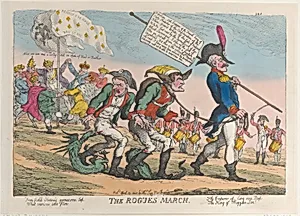
Among his most famous works are the *Vauxhall Gardens* scene (exhibited 1784), which teems with recognizable figures from London society, and the wildly popular *Tour of Dr. Syntax in Search of the Picturesque* (1812) and its sequels, created in collaboration with publisher Rudolph Ackermann and writer William Combe. He also produced the *English Dance of Death* (1815–16), illustrations for novels by Smollett, Goldsmith, and Sterne, and numerous political and social satires targeting figures like Napoleon and the Duchess of Devonshire, alongside private erotic works. Rowlandson helped shape the enduring image of John Bull as a national personification alongside Gillray and George Cruikshank.
Rowlandson died in London on 21 April 1827. His legacy endures through his vivid record of late eighteenth- and early nineteenth-century British society, influencing generations of illustrators and remaining a cornerstone of Georgian visual culture. His drawings and prints continue to delight viewers with their blend of exuberance, satire, and keen humanity.