
Ctrl K
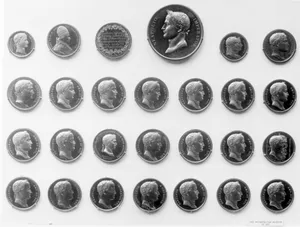
**J. B. Merlen (Jean Baptiste or Johann Baptist Merlen)** was a Flemish-origin medallist and coin engraver of Dutch nationality whose career spanned the Napoleonic era and the early decades of British coinage reform. Born around 1769, possibly in Antwerp, his early life and training remain sparsely recorded, though sources indicate he learned his craft in Brussels before entering professional work. He established himself at the Paris Mint during the First Empire, producing medals and jetons that demonstrated his skill in detailed figurative and heraldic engraving.
At the Paris Mint, Merlen created one of his most notable early works: the 1804 medal commemorating Napoleon’s coronation as Emperor. The piece depicts Napoleon, crowned and borne aloft on a shield by four warriors, with inscriptions evoking imperial virtues; it was struck under the direction of Baron Dominique Vivant Denon, who oversaw the Monnaie des Médailles and official Napoleonic propaganda medals. Merlen signed several related jetons and medals from this period, including pieces for the Medical Society of Brussels (featuring Andreas Vesalius) and various Parisian lodges and administrations. After Napoleon’s defeat at Waterloo in 1815, Merlen’s position became uncertain, prompting his move to London.
From February 1820, Merlen served as Extra Assistant Engraver at the Royal Mint, working alongside Benedetto Pistrucci and William Wyon (hired on a weekly rather than permanent basis because he was a foreign national). He excelled in reverse designs, most famously the crowned shield of the Royal Arms surrounded by a wreath or Garter, used on George IV half-crowns (1820–21, with his initials J.B.M. visible), sovereigns, and later issues of William IV and Queen Victoria. He also engraved the bare-headed obverse portrait of George IV (after Sir Francis Chantrey) for the 1823 gold double sovereign—the first circulating two-pound coin and the first male monarch shown without crown or laurel since Edward VI. His Maundy money reverses remained in use until 1887.
Merlen’s precise, neoclassical style—characterized by elegant heraldry, balanced composition, and technical mastery of punches and lettering—left a lasting mark on British numismatics. His shield-back designs defined Victorian gold coinage for decades and continue to be celebrated in modern commemorative issues. He retired from the Royal Mint in 1844 and died in 1850. Though often overshadowed by more famous colleagues, Merlen’s contributions bridged French imperial medal-making and the refined British coinage of the 19th century, making him a key figure in the history of European engraving.
All 1 artworks loaded