
Ctrl K
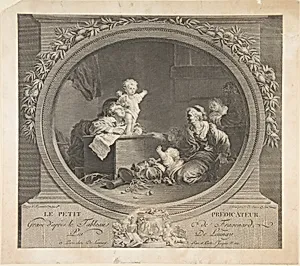
**Nicolas de Launay (1739–1792)** was a distinguished French engraver of the late Rococo period, renowned for his refined technique and his celebrated reproductions of paintings by leading artists of his day. Born in Paris on September 20, 1739, he entered the studio of Louis-Simon Lempereur at a young age and quickly mastered the art of engraving in multiple genres, including history, portraiture, landscape, and book illustration.
Launay trained under Lempereur and developed a fluid, precise burin style that captured the sensuality and lightness of Rococo subjects. He became particularly noted for his engravings after Jean-Honoré Fragonard, including *Les Hazards heureux de l’escarpolette* (*The Swing*), *La Bonne mère*, and *Le Chiffre d’Amour*. He also produced notable works after Jan Baptist Weenix (*Partie de plaisirs*), Étienne Aubry, Rubens (*Marche de Silène*), and designs by Charles-Nicolas Cochin and Jean-Michel Moreau for literary editions such as the *Metamorphoses* of Ovid and works by Rousseau and Molière.
Elected to the Académie de Copenhague and agréé by the Académie royale de peinture et de sculpture in 1789, Launay was later appointed graveur du roi. He maintained a workshop on rue de la Bûcherie and trained several pupils, including Jean-Louis Delignon; his younger brother Robert de Launay also became an engraver. Launay died in Paris on March 2, 1792. His prints remain prized for their technical elegance and their role in disseminating the playful, intimate spirit of French eighteenth-century painting.