
Ctrl K
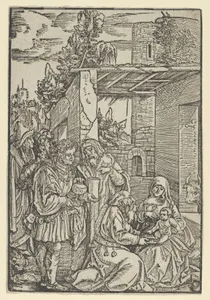
**Hans Leonhard Schäufelein (c. 1480–c. 1540)** was a German painter, draftsman, and prolific designer of woodcuts active during the Northern Renaissance. Born in Nuremberg, he trained under the painter Michael Wolgemut and later worked as an assistant to Albrecht Dürer, whose style he closely imitated in his early career.
Schäufelein’s career took him from Nuremberg to Augsburg and finally to Nördlingen, where he settled around 1515. In 1508–09 he worked as a journeyman in Tyrol, producing numerous altarpieces. After returning to Augsburg he collaborated with Hans Burgkmair and others on major imperial print projects for Emperor Maximilian I, including woodcuts for the *Weisskunig* and *Theuerdank*. He also created independent paintings, such as the *Last Supper*, and designed hundreds of book illustrations, notably contributing most of the 150 woodcuts for a 1507 collection of New Testament texts.
His graphic work is characterized by clear narrative compositions, expressive figures, and a blend of Dürer’s precision with his own lively storytelling. While his paintings are fewer and less documented, his woodcuts and book illustrations ensured wide dissemination of his designs across German-speaking lands.
Schäufelein’s legacy lies in his role as a bridge between the great Nuremberg masters and the next generation of printmakers. His illustrations helped shape the visual culture of the early Reformation era, and his works remain in major museum collections today, valued for their technical skill and historical insight into 16th-century German art.