
Ctrl K
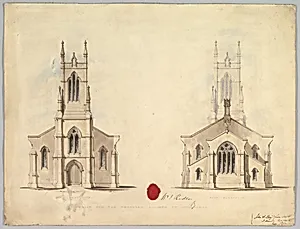
John Green (1787–1852) and his son Benjamin Green (1813–1858) were a father-and-son partnership of architects and civil engineers based in Newcastle upon Tyne, active across North East England in the early nineteenth century. John, born on 29 June 1787 at Newton Fell House near Nafferton, Northumberland, was the son of a village carpenter and began his career in building and architectural work before establishing himself as an architect and engineer in Newcastle around 1820. Benjamin, born 9 January 1813, trained as a pupil of the architectural draughtsman Augustus Charles Pugin and joined his father in partnership by the mid-1830s. Their collaborative output blended civil engineering projects—primarily John’s domain—with more ornamental architectural designs often credited to Benjamin.
Their artistic contributions are best seen in surviving architectural drawings and watercolours, such as the detailed design for the proposed Church at Middlesbrough (1837), executed in pen and brown ink with watercolor washes. These works reflect the era’s neoclassical and Gothic Revival influences, combining precise technical rendering with decorative flair. Benjamin’s more ornamental, florid style contrasted with his father’s plainer, practical approach, evident in joint projects like churches at Earsdon and Cambo, numerous railway stations along the Newcastle to Berwick line, and iconic Newcastle landmarks including the Theatre Royal (1837) and the column of Grey’s Monument (1838). Other notable designs include the Penshaw Monument (1844), a half-scale replica of the Temple of Hephaestus, and innovative laminated timber viaducts at Ouseburn and Willington.
The Greens produced over 100 attributed works, with roughly three-quarters surviving, encompassing churches, farms, bridges, and public buildings that shaped the region’s infrastructure and urban landscape during the railway age. Drawings by both men are preserved in collections including the Laing Art Gallery in Newcastle. John died in Newcastle on 30 September 1852; Benjamin survived him by only six years, passing away on 14 November 1858. Their partnership left a lasting legacy in the architectural and engineering heritage of North East England, blending functional innovation with visual elegance.