Ctrl K
Johann Teyler (1648–c. 1709), a Dutch polymath born in Nijmegen, initially pursued academic studies in Latin and mathematics at the local Latin school and the Kwartierlijke Academie, where he defended a dissertation supporting Descartes' philosophy. The son of William Taylor, an English or Scottish mercenary who adopted the name Teyler, he continued his education in Leiden following his father's death. Though registered as a painter and engraver, Teyler worked primarily as a military engineer in Brandenburg service and as an organizer of print workshops rather than a hands-on artist. He traveled in artistic circles, including membership in the Bentvueghels in Rome under the nickname "Speculatie," and collaborated with figures like Jan van Call, his former mathematics pupil.
From around 1685 to 1697, Teyler's workshops in Amsterdam and Rijswijk revolutionized printmaking with his patented 1688 technique of *à la poupée* inking—applying multiple colors to a single intaglio plate using a cloth-wrapped "doll" for nuanced, vibrant effects. This allowed up to ten hues per impression, blending marbled transitions in glowing yellows, reds, greens, and blues on paper and fabrics like silk and linen for wall hangings or fire screens. Operating as financier and director, Teyler employed engravers and designers to produce over 400 color etchings and engravings in the Dutch Golden Age tradition, spanning animals, insects, landscapes, town views, mythological scenes, and military diagrams.
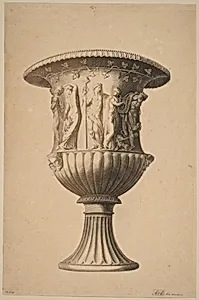
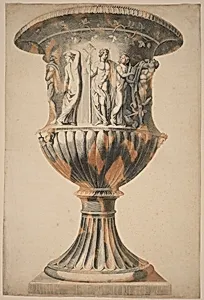
Among the workshop's output were naturalistic studies like *Lizard*, *Snake and Butterfly*, *Pissing Cow and Two Sheep*, and *Parrot*, alongside architectural marvels such as the *Borghese Vase* (c. 1685–1697), an engraving after designs by French painter, engraver, and Académie Royale co-founder Charles Errard (c. 1606/09–1689). Errard's classical drawings, drawn from Roman antiquities, were faithfully rendered in Teyler's multi-toned browns and blacks, exemplifying the workshop's precision in reproducing antique-inspired motifs. Other notable series included views like *Amsterdam, Ships at the IJ on Choppy Water* after Johannes van den Aveele.
Teyler's innovations spread rapidly; Amsterdam publishers adopted the method until around 1710, influencing book illustrations and color prints across Europe into the eighteenth century. His workshop's auction in 1698 dispersed plates and textiles, but surviving impressions in collections like the National Gallery of Art and Rijksmuseum preserve his legacy as a pioneer who transformed printmaking from monochrome to a painterly spectacle.
All 2 artworks loaded