
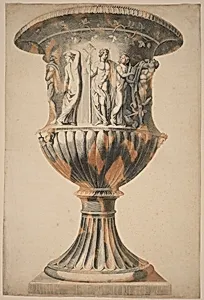
Borghese Vase
c. 1685-1697
Medium
color engraving inked à la poupée on laid paper
Dimensions
sheet (trimmed within plate mark): 51 x 34.5 cm (20 1/16 x 13 9/16 in.)
Classification
Department
CG-E
Museum
National Gallery of Art, Washington, D.C.
Credit
Rosenwald Collection
Accession Number
1946.21.53
Rights
Public Domain
Art Historical Context
Welcome to the National Gallery of Art, where we encounter the *Borghese Vase*, a stunning color engraving produced in the workshop of Dutch engraver Johann Tey around 1685–1697. Created after designs by French artist Charles Err, this print faithfully reproduces one of antiquity's most celebrated artifacts: a massive ancient Roman marble vase from the Borghese collection, for its elaborate reliefs depicting mythological scenes. Measuring 51 x 34.5 cm on laid paper, it captures the vase's grandeur in intricate detail, bridging the classical past with the Baroque era's fascination for ancient art. What sets this work apart is its pioneering medium—a color engraving inked *à la poupée*. In this innovative technique, engravers used stuffed fabric "dolls" (poupées) to apply vibrant inks directly onto the plate, producing rich, multi-hued impressions from a single run through the press. Developed in the late 17th century, it allowed for affordable, vivid dissemination of classical motifs to collectors and scholars across Europe, fueling the neoclassical revival. Part of the esteemed Rosenwald Collection in the museum's Prints department, this piece highlights the era's scholarly passion for Greco-Roman heritage. Imagine 18th-century aristocrats poring over such prints, dreaming of Rome's lost splendor—it's a window into how art preserved and popularized the antique world for modern eyes.
About the Artist
Workshop of Johann Teyler, after Charles Errard
Johann Teyler (1648–c. 1709), a Dutch polymath born in Nijmegen, initially pursued academic studies in Latin and mathematics at the local Latin school and the Kwartierlijke Academie, where he defended a dissertation supporting Descartes' philosophy. The son of William Taylor, an English or Scottish mercenary who adopted the name Teyler, he continued his education in Leiden following his father's d...