Ctrl K
**Hendrik Hondius I (1573–c. 1650)** was a Flemish-born engraver, cartographer, and publisher who became a leading figure in the Dutch Golden Age print trade after settling in The Hague in 1597. Born Hendrik de Hondt in Duffel in the Duchy of Brabant, he trained initially as a goldsmith under Godfried van Ghelder in Brussels before studying drawing with the Antwerp engraver Jan Wierix. He further honed his skills in mathematics, perspective, architecture, and fortification with Hans Vredeman de Vries and Samuel Marelois, travels to Cologne, London, and Paris broadening his technical and artistic horizons.
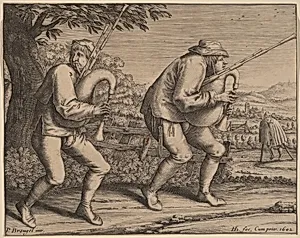
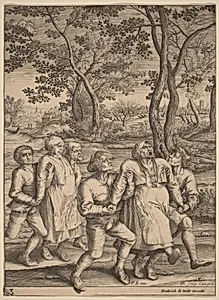
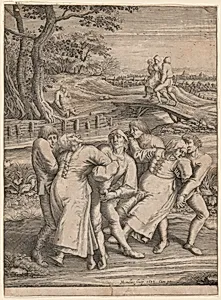
Hondius established a flourishing workshop in The Hague, where he registered with the artists’ guild and secured royal and national printing privileges as early as 1599—the first such protection granted to a publisher in the Dutch Republic. His output combined original designs with reproductive engravings after earlier masters, including Pieter Bruegel the Elder. Notable among these are his 1642 engraving *Epileptics Walking to the Right* and other prints that faithfully translated Bruegel’s lively compositions into the medium of etching and engraving. He also produced the influential 1610 series *Pictorum aliquot celebrium praecipue Germaniae Inferioris Effigies*, a collection of 69 artist portraits that updated and expanded earlier Netherlandish canons with Latin verses celebrating each sitter’s achievements.
In addition to portraits and reproductive prints, Hondius published maps, fortification treatises, and perspective manuals, often collaborating with or reissuing plates by earlier artists. His business later passed to his sons Willem and Hendrik, ensuring the continuation of the family enterprise. Hondius remained active into his final years, shifting emphasis from engraving to etching while maintaining a reputation for precision and scholarly ambition.
Today his prints after Bruegel and his portrait series stand as vital documents of 17th-century Netherlandish artistic heritage, preserving the visual legacy of earlier generations for collectors and scholars alike. Three examples of his work after Bruegel are held in the museum’s collection, underscoring his enduring role as both interpreter and transmitter of Flemish pictorial traditions within the Dutch Republic.
All 3 artworks loaded