Ctrl K
1860–1939
**Alphonse Maria Mucha (1860–1939)** was a Czech painter, illustrator, and graphic artist whose elegant, decorative style became synonymous with Art Nouveau. Born on 24 July 1860 in the small town of Ivančice in southern Moravia (then part of the Austrian Empire), he was the eldest of six children in a modest family; his father Ondřej worked as a court usher and his mother Amálie was a miller’s daughter.
Mucha’s artistic path began with practical training rather than formal academy acceptance. After early work painting theatrical scenery in Vienna, he gained the patronage of Count Karl Khuen-Belasi, who funded his studies at the Munich Academy of Fine Arts in 1885. He later moved to Paris, enrolling at the Académie Julian (studying under Jules Lefebvre and Jean-Paul Laurens) and the Académie Colarossi. These experiences shaped his command of figure drawing, historical themes, and lush ornamentation.
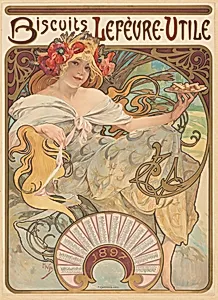
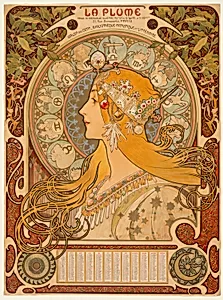
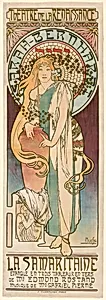
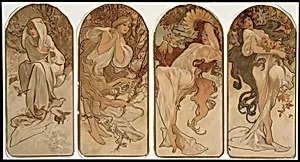
In Paris during the 1890s, Mucha achieved fame with his theatrical posters, particularly the 1895 *Gismonda* for Sarah Bernhardt, which launched the distinctive “Mucha Style.” Characterized by sinuous lines, floral motifs, pastel colors, and graceful female figures often framed by halos or arches, his work defined the emerging Art Nouveau movement. He produced iconic series such as *The Seasons* (1896 and later iterations) and countless advertisements, decorative panels, and illustrations. Later in life, after returning to his homeland, he devoted himself to the monumental *The Slav Epic* (painted 1912–1926), a cycle of twenty canvases celebrating Slavic history and mythology that he presented to the Czech nation in 1928.
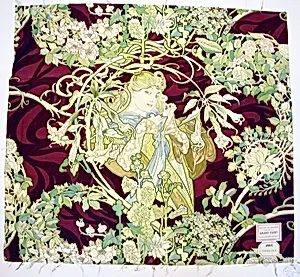
Mucha married Marie (Maruška) Chytilová in 1906; they had two children, including daughter Jaroslava. He received honors including the French Legion of Honour and died in Prague on 14 July 1939. His legacy endures as one of the most influential figures of Art Nouveau, whose commercial posters elevated graphic design to fine art while his later epic works expressed deep cultural and national ideals. His distinctive imagery continues to inspire designers and remains widely reproduced today.