
Biscuits Lefèvre-Utile
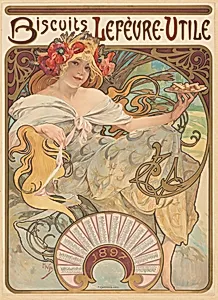
Medium
color lithograph on paper laid down on linen
Dimensions
sheet: 61.28 × 43.5 cm (24 1/8 × 17 1/8 in.)
Classification
Department
CG-E
Museum
National Gallery of Art, Washington, D.C.
Credit
Evelyn Stefansson Nef Fund
Accession Number
2016.140.2
Rights
Public Domain
Art Historical Context
Alphonse Mucha’s 1896 color lithograph *Biscuits Lefèvre-Utile* exemplifies the vibrant marriage of fine art and commercial advertising at the turn of the twentieth century. Mucha, a leading figure of the Art Nouveau movement, brought his distinctive linear elegance and decorative sensibility to this poster for the French biscuit company LU. The work captures the era’s fascination with graceful female figures and stylized ornament, transforming a simple product advertisement into an object of visual delight. Printed as a color lithograph on paper mounted on linen, the medium allowed for rich, saturated hues and broad distribution—qualities that helped posters become a dominant form of public art in fin-de-siècle Paris. Mucha’s design reflects the period’s growing consumer culture, when manufacturers increasingly commissioned artists to lend beauty and prestige to everyday goods. Today the print stands as both a charming souvenir of Belle Époque advertising and a testament to Mucha’s lasting influence on graphic design. Its presence in the National Gallery of Art’s collection highlights how commercial imagery from the 1890s helped shape modern visual culture.
About the Artist
Alphonse Marie Mucha · 1860–1939
**Alphonse Maria Mucha (1860–1939)** was a Czech painter, illustrator, and graphic artist whose elegant, decorative style became synonymous with Art Nouveau. Born on 24 July 1860 in the small town of Ivančice in southern Moravia (then part of the Austrian Empire), he was the eldest of six children in a modest family; his father Ondřej worked as a court usher and his mother Amálie was a miller’s da...