Ctrl K
1761–1844
André Galle (1761–1844) was a distinguished French engraver and medallist whose career spanned the Revolutionary, Napoleonic, and Restoration periods, making him a witness to and chronicler of some of the most dramatic decades in French history. Born in Saint-Étienne and spending his professional life in Paris, Galle specialized in the production of medals, seals, and stamps—small-scale works of commemorative and functional art that required exceptional technical precision and iconographic sophistication. His elevation to Master Engraver in 1785, shortly before the Revolution, marked the beginning of a career that would see him navigate the successive political regimes of France while maintaining continuous professional activity and official recognition. Galle's medals documented pivotal moments in French history, from Revolutionary organizations through Napoleon's Egyptian campaigns to the Emperor's coronation. His work exemplified the medallic tradition's dual function as artistic achievement and political instrument, translating historical events and official iconography into durable, distributable objects. His election to the Académie des Beaux-Arts in 1819 and his investiture as Knight of the Legion of Honor in 1826 confirmed his standing among France's artistic elite, while his long career—spanning sixty years from the ancien régime through the constitutional monarchy—demonstrated remarkable professional longevity and adaptability.
André Galle was born on May 27, 1761, in Saint-Étienne, a city in the Loire region known for its metalworking industries. Growing up in this environment of skilled craftsmanship likely influenced Galle's later choice of profession, as medal engraving demanded similar precision and technical expertise.
He traveled to Paris to pursue his artistic training, entering the rigorous apprenticeship system that prepared engravers for professional practice. The craft of medal engraving required mastery of multiple techniques: die-cutting, relief modeling, lettering design, and the manipulation of metals. Engravers studied classical models, learned the conventions of allegorical representation, and developed the manual skills necessary to work at miniature scale with absolute precision.
In 1785, at age twenty-four, Galle achieved the rank of Master Engraver, a professional qualification that permitted him to establish his own practice and accept commissions. This accomplishment came just four years before the Revolution that would transform French society and reshape the conditions of artistic production.
Four years after becoming a master, in 1789—the year of the Revolution's outbreak—Galle opened his own engraving studio in Paris. With the ancien régime collapsing and new political institutions rapidly forming, Galle found a lucrative specialty: producing seals and stamps for the numerous Revolutionary organizations that proliferated during this tumultuous period. These functional objects, bearing the symbols and mottos of Revolutionary committees, clubs, and administrative bodies, required rapid production and strict adherence to prescribed iconography.
His decision to remain in Paris during the Revolutionary period, when many artists associated with the old regime fled or withdrew from public activity, positioned him advantageously. He established working relationships with the new regime's artistic administrators, most notably Augustin Dupré, who had been appointed Engraver General of coins and medals in 1791. This collaboration would prove crucial for Galle's subsequent career development.
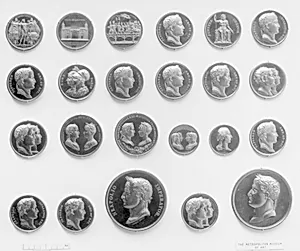
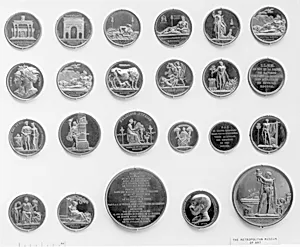
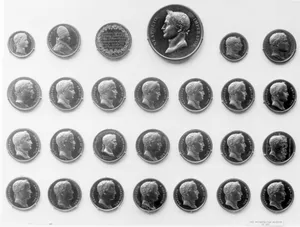
During the Consulate and Empire, Galle's career reached its zenith. Working alongside Dupré, he participated in the systematic program of commemorative medals that glorified Napoleon's military campaigns and political achievements. These medals served as official propaganda, distributed to officers, dignitaries, and allies as tokens of imperial favor, while also functioning as portable artistic records of historical events.
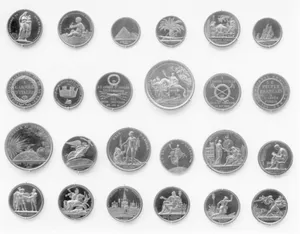
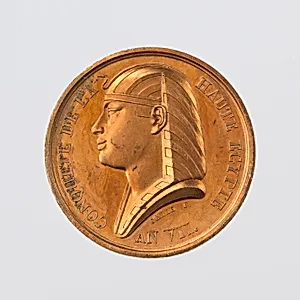
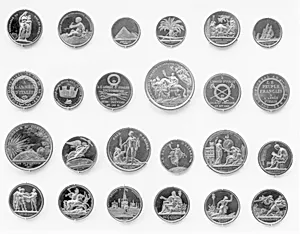
Among his significant projects was a series of medals celebrating the French campaign in Egypt and Syria (1798–1801). Napoleon's Egyptian expedition, though ultimately a military failure, captured public imagination through its romantic exoticism and scientific discoveries. Galle's medals translated the campaign's highlights into classical allegorical language, depicting pyramids, sphinxes, and military victories in compositions that emphasized French heroism and civilizing mission.
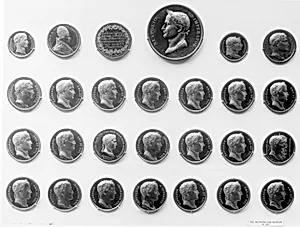
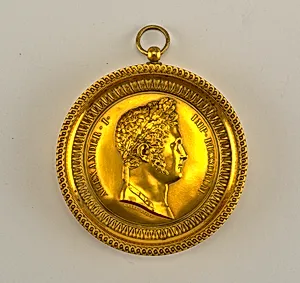
His most prestigious commission came in collaboration with Romain-Vincent Jeuffroy for the occasion of Napoleon's coronation as Emperor in December 1804. This medal commemorated one of the most significant moments in European political history, when Napoleon transformed the Revolutionary republic into a hereditary empire. The medal's design required careful balance between imperial grandeur and Revolutionary legitimacy, classical references and contemporary political messaging.
The Napoleonic medals demonstrated Galle's technical mastery: crisp relief modeling, elegant lettering, sophisticated compositional balance within the circular format, and successful translation of complex historical narratives into compressed visual form. His medals joined the tradition extending from ancient Rome through the Renaissance, asserting continuity between Napoleon's empire and classical imperial precedents.
Following Napoleon's fall and the Bourbon Restoration, Galle successfully transitioned to the new regime, continuing his productive career under yet another political system. His ability to serve successive governments—Revolutionary, Napoleonic, and Restoration—testified to his professional skill and diplomatic adaptability.
In 1819, Galle received one of the highest honors available to a French artist: election to the Académie des Beaux-Arts, the premier institution governing artistic standards and professional recognition in France. He occupied Seat #3 for engraving, joining an institution that included painters, sculptors, architects, and composers among France's cultural elite. This election confirmed that medal engraving, often dismissed as minor or decorative art, could achieve recognition equal to the traditional fine arts.
In 1826, he was named a Knight of the Legion of Honor, the decoration established by Napoleon that had survived into the Restoration as France's premier civil and military honor. This investiture recognized both his artistic achievements and his service to the French state across multiple regimes.
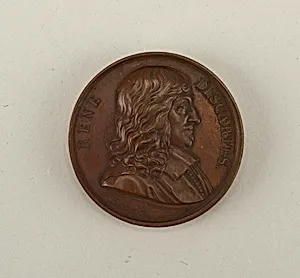
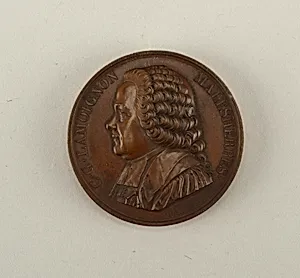
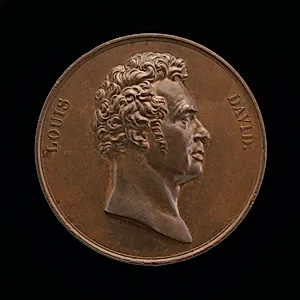
Galle continued active production throughout the 1820s and 1830s. The National Gallery of Art preserves examples of his work from this late period, including bronze medals dated 1820 that demonstrate his sustained technical excellence into his sixties.
André Galle died in Paris on December 21, 1844, at the age of eighty-three. His remarkably long career—spanning from the ancien régime through the Revolution, Empire, and Restoration into the July Monarchy—made him a living link between pre-Revolutionary artistic traditions and nineteenth-century medallic practice. His extensive oeuvre documents French political history through the medium of commemorative medals, while his technical virtuosity upheld the highest standards of an exacting craft.
Artheon Research Team
Last updated: 2025-11-09
Biography length: ~482 words
![Inscription [reverse]](https://images.artheonmuseum.org/nga/thumb/inscription-reverse-nga-162052.webp)