
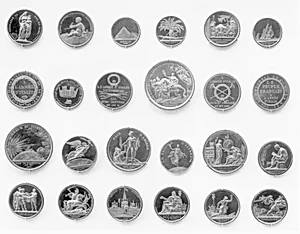
Bonaparte's Return to Fréjus, 1799
Medium
Gilt bronze, struck
Dimensions
Diameter: 33 mm
Classification
Medals and Plaquettes
Culture
French
Department
European Sculpture and Decorative Arts
Museum
Metropolitan Museum of Art, New York, NY
Credit
Gift of Hon. Levi P. Morton, 1885
Accession Number
85.2.32
Rights
Public Domain
Art Historical Context
In the turbulent wake of the French Revolution, this exquisite gilt bronze medal captures a pivotal moment: Napoleon Bonaparte's triumphant return toéjus on October 9, 1799, after his Egyptian campaign. Landing amid cheers from adoring crowds, Bonaparte was hailed as a hero, paving the way for his coup d'état just weeks later, which elevated him to First Consul and reshaped Europe. Struck that same year by the Paris Mint, the 33 mm medallion—crafted by engraver André Galle under the artistic direction of Baron Dominique Vivant Denon—serves as a snapshot of Napoleonic propaganda, glorifying the general's charisma and military prowess. Galle's precise engraving techniques, enhanced by gilding for a luxurious sheen, highlight the medal's dual role as both portable art and political emblem. Denon, a polymath who later directed the Louvre, brought neoclassical elegance to the design, blending heroic portraiture with symbolic motifs typical of French Revolutionary medals. These small-scale plaquettes were collectibles for the elite, disseminating Bonaparte's image far beyond Fréjus. Today, housed in the Metropolitan Museum of Art's European Sculpture and Decorative Arts Department (gift of Hon. Levi P. Morton, 1885), it reminds us how art fueled ambition in an era of upheaval, turning personal glory into national myth.
About the Artist
André Galle|baron Dominique Vivant Denon|Paris Mint · 1761–1844
André Galle (1761–1844) was a distinguished French engraver and medallist whose career spanned the Revolutionary, Napoleonic, and Restoration periods, making him a witness to and chronicler of some of the most dramatic decades in French history. Born in Saint-Étienne and spending his professional life in Paris, Galle specialized in the production of medals, seals, and stamps—small-scale works of c...