
Ctrl K
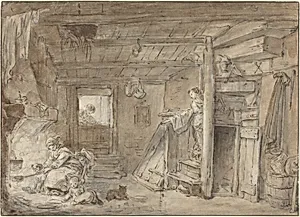
**Hubert Robert (1733–1808)** was a French painter celebrated for his evocative landscapes and capricci—semi-fictitious, picturesque scenes of ancient ruins set amid idealized Italian and French settings. Born in Paris on 22 May 1733, he came from a family connected to the influential Choiseul diplomatic circle; his father, Nicolas Robert, served François-Joseph de Choiseul, marquis de Stainville. After completing his studies with the Jesuits at the Collège de Navarre in 1751, Robert entered the atelier of the sculptor Michel-Ange Slodtz, who instructed him in design and perspective while steering him toward painting.
In 1754, Robert traveled to Rome in the entourage of Étienne-François de Choiseul, remaining there for eleven years. He trained at the French Academy in Rome, worked in the studio of Giovanni Paolo Panini, and absorbed the dramatic architectural visions of Giovanni Battista Piranesi. He formed a close friendship with Jean-Honoré Fragonard and joined the Abbé de Saint-Non on sketching expeditions through southern Italy, including visits to Pompeii and the gardens of the Villa d’Este. These experiences supplied the motifs for his lifelong fascination with crumbling monuments animated by small figures and overgrown vegetation, earning him the nickname “Robert des Ruines.”
Returning to Paris in 1765, Robert achieved swift success. He was received into the Académie royale de peinture et de sculpture the following year and exhibited regularly at the Salon from 1767 onward. Appointed Designer of the King’s Gardens and later Keeper of the King’s Pictures, he produced an immense body of work—roughly a thousand paintings and ten thousand drawings—ranging from intimate red-chalk studies to large decorative canvases. Notable examples include his red-chalk drawings of the Villa d’Este gardens, the *Imaginary View of the Grand Gallery of the Louvre in Ruins* (1796), and scenes documenting the upheavals of the French Revolution, during which he was briefly imprisoned yet continued to paint. He also contributed atmospheric designs for picturesque gardens at sites such as Méréville and the Petit Trianon.
Robert died in Paris on 15 April 1808 after a stroke. His legacy endures as a master of the Romantic ruin aesthetic, bridging Rococo elegance and emerging Romantic sensibility. His works populate major collections worldwide, including the Louvre, and continue to shape perceptions of the picturesque in both painting and landscape architecture. Works attributed to him, such as the single piece in the present collection, reflect the enduring appeal of his visionary style.