
Interior of a Farmhouse with Figures
late 18th century
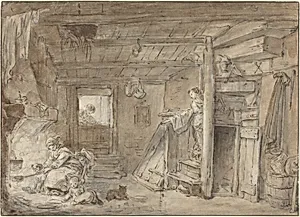
Medium
pen and brown and black ink with brown wash heightened with white over black chalk on laid paper
Dimensions
overall: 17.8 x 24.8 cm (7 x 9 3/4 in.)
Classification
Drawing
Department
CG-E
Museum
National Gallery of Art, Washington, D.C.
Credit
Samuel H. Kress Collection
Accession Number
1963.15.8
Rights
Public Domain
Art Historical Context
Step into the humble warmth of *Interior of a Farmhouse Figures*, a delicate drawing attributed to the French artist Hubert Robert from the late 18th century. Robert, often called "Robert des Ruines for his evocative depictions of ancient architecture bathed in soft light, here turns his gaze to everyday rural life. This intimate scene captures the rustic charm of a farmhouse interior, populated by figures engaged in daily activities, offering a rare glimpse into domestic tranquility amid the grandeur of neoclassical art. Executed on laid paper with pen and brown and black ink, brown wash heightened with white over black chalk, the work showcases masterful mixed-media techniques typical of preparatory sketches from the era. At just 17.8 x 24.8 cm, its small scale invites close inspection, revealing Robert's skill in layering tones to create depth and atmosphere—wash for subtle shadows, white heightening for luminous highlights. Such drawings were prized by collectors for their spontaneity and fidelity to light, bridging Robert's fantastical landscapes with grounded realism. Housed in the National Gallery of Art's Samuel H. Kress Collection (Department CG-E), this piece reflects the 18th-century fascination with pastoral simplicity during France's Ancien Régime, just before the Revolution. It invites visitors to ponder how even a master of ruins found poetry in the ordinary hearth.
About the Artist
Attributed to Hubert Robert
**Hubert Robert (1733–1808)** was a French painter celebrated for his evocative landscapes and capricci—semi-fictitious, picturesque scenes of ancient ruins set amid idealized Italian and French settings. Born in Paris on 22 May 1733, he came from a family connected to the influential Choiseul diplomatic circle; his father, Nicolas Robert, served François-Joseph de Choiseul, marquis de Stainville....