Ctrl K
1505–1571
Bartolomeo Neroni, known as Il Riccio or Riccio Sanese, was a multifaceted artist of the Sienese School, born around 1505 in Siena, Italy, where he spent his life and died in 1571. A painter, sculptor, architect, engineer, and even manuscript illuminator, Neroni exemplified the Renaissance ideal of the polymath, blending artistic creativity with practical ingenuity. His nickname "Il Riccio," meaning "the curly one," likely referred to his hair, and he earned renown in his lifetime not only for his visual arts but also for military engineering and theatrical designs, as chronicled by Giorgio Vasari in his *Lives of the Artists*.
Neroni trained under the esteemed Sienese painter Il Sodoma, becoming his pupil and eventually marrying the master's daughter, forging a deep familial and professional bond. This apprenticeship immersed him in the Mannerist tendencies of the Sienese tradition, while he drew clear influences from contemporaries like Domenico Beccafumi and Baldassare Peruzzi, whose elegant compositions and architectural precision shaped his style. Working firmly within the Sienese School, Neroni's works often featured graceful figures, dramatic lighting, and intricate details, reflecting the region's blend of Gothic lingering and emerging Mannerism.
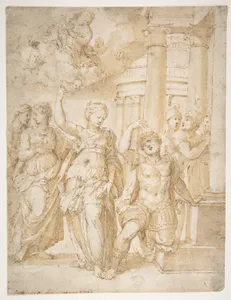
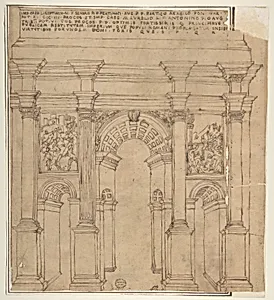
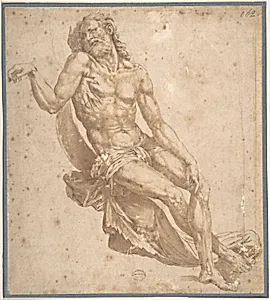
Among his surviving pieces, Neroni's *Study for Christ in The Entombment* (16th century, Metropolitan Museum of Art) showcases his mastery of brush and wash over chalk, capturing tender pathos in preparatory drawing. An attributed view of the *Arch of Constantine, Rome* (also Met) highlights his architectural eye, while a tempera *Figura Allegorica* (c. 80 x 49 cm) survives from private collections. Much of his output was ephemeral: he designed the elaborate scenography for the comedy *L'Ortensio*, staged in Florence's Salone delle Commedie for Grand Duke Cosimo I de' Medici, blending painting, sculpture, and engineering in grand spectacle.
Though many works have been lost to time, Neroni's legacy endures through Vasari's praise and scattered treasures in museums like the Met. His versatility bridged art and utility, influencing Sienese successors and underscoring the era's innovative spirit, where painters doubled as innovators in design and defense. Today, he remains a testament to Siena's rich, if underappreciated, Renaissance contributions.
(Word count: 348)