
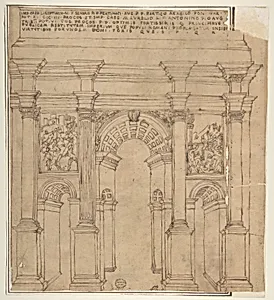
Arch of Septimius Severus, Rome
Medium
Pen and ink, brush and brown wash
Dimensions
11 1/16 x 10 1/8in. (28.1 x 25.7cm)
Classification
Drawings
Department
Drawings and Prints
Museum
Metropolitan Museum of Art, New York, NY
Credit
Gift of Cornelius Vanderbilt, 1880
Accession Number
80.3.632
Rights
Public Domain
Tags
Art Historical Context
Behold the intricate *Arch of Septimius Severus Rome*, a captivating drawing by the Sienese artist Bartolomeo Ner, known as Il Riccio (5–1571). Created during the Renaissance with pen and ink heightened by brush and brown wash this 11 1/16 x 10 1/8-inch sheet masterfully captures the grandeur of one of ancient Rome's most iconic triumphal arches, erected in 203 AD to celebrate Emperor Septimius Severus's victories the Parthians. Neroni's precise lines and subtle washes evoke the arch's towering three-bay structure, adorned with relief sculptures of battles and imperial processions, inviting viewers to marvel at Rome's enduring legacy. This work exemplifies the Renaissance obsession with classical antiquity, as artists like Neroni traveled to study and sketch ancient monuments for inspiration in their own designs. The pen-and-ink technique, with its fluid strokes and tonal depth from brown wash, allowed for detailed architectural rendering—ideal for architects, painters, and scholars documenting Rome's ruins amid the era's revival of Greco-Roman ideals. Housed in the Metropolitan Museum of Art's Drawings and Prints department, it entered the collection as a gift from Cornelius Vanderbilt in 1880, preserving a window into 16th-century artistic curiosity. Today, this modest yet evocative study reminds us how Renaissance draughtsmen bridged past and present, turning stone relics into living sources of beauty and history.
About the Artist
Bartolomeo Neroni (Il Riccio) · 1505–1571
Bartolomeo Neroni, known as Il Riccio or Riccio Sanese, was a multifaceted artist of the Sienese School, born around 1505 in Siena, Italy, where he spent his life and died in 1571. A painter, sculptor, architect, engineer, and even manuscript illuminator, Neroni exemplified the Renaissance ideal of the polymath, blending artistic creativity with practical ingenuity. His nickname "Il Riccio," meani...