Ctrl K

1757–1827
Movements
Occupations
William Blake (1757–1827) stands as one of the most visionary and unconventional artists in British history, a poet-painter-printmaker whose mystical imagination and radical vision profoundly shaped the Romantic movement. Born in London's Soho district, Blake experienced visions from childhood—claiming to see angels in trees at age eight—and these spiritual encounters would guide his art throughout his life. Largely unrecognized during his lifetime and often dismissed as eccentric or even mad, Blake has since been acknowledged as the 'father of Romanticism' and a seminal figure in both the poetry and visual art of his era. Blake's revolutionary contribution to art lay in his invention of 'illuminated printing,' a unique relief-etching technique that allowed him to integrate text and image on the same copper plate. This innovation freed him from commercial constraints and censorship, enabling him to produce his most celebrated works—Songs of Innocence (1789), Songs of Experience (1794), The Marriage of Heaven and Hell, and his prophetic books Milton and Jerusalem. Each illuminated book was hand-printed, hand-colored, and unique, combining his gifts as poet and visual artist into integrated masterworks. Blake's art championed imagination over reason, challenging Enlightenment rationalism with visionary spirituality. He developed a complex symbolic mythology featuring figures like Urizen (representing oppressive authority) and Orc (symbolizing creative rebellion), exploring fundamental dualities of innocence and experience, good and evil, freedom and tyranny. Though he struggled financially throughout his life and sold fewer than 30 copies of Songs during his lifetime, Blake's influence proved profound and enduring. His visionary approach inspired Pre-Raphaelites, Symbolists, Modernists, and countless poets from Yeats to Ginsberg, establishing him as one of the greatest creative minds in the English tradition.
Born November 28, 1757, at 28 Broad Street (now Broadwick Street) in Soho, London, William Blake was the third of seven children born to James Blake, a hosier, and his wife Catherine. Two of his siblings died in infancy. Blake's parents were Nonconformists in religion, and this dissenting tradition shaped his lifelong opposition to established authority, whether religious or political.
Blake's visionary experiences began in early childhood. At age four, he claimed to have seen God 'put his head to the window,' and at eight or ten, while walking on Peckham Rye, he saw 'a tree filled with angels, bright angelic wings bespangling every bough like stars.' These visions were not metaphorical for Blake—he firmly believed he was in direct presence of the spiritual figures and scenes he portrayed throughout his life.
Blake attended school only long enough to learn reading and writing, leaving at age ten to be educated at home by his mother. Recognizing his artistic talent, his parents enrolled him in drawing classes at Henry Pars's drawing school in the Strand, where he learned to draw from plaster casts of ancient sculptures.
On August 4, 1772, at age fourteen, Blake was apprenticed to the engraver James Basire (1730–1802) for a seven-year term at the cost of £52.10s. Basire, a Fellow of the Society of Antiquaries, practiced an old-fashioned line-engraving technique considered outmoded compared to the fashionable stipple and mezzotint methods. Beginning in 1774, Basire sent Blake to Westminster Abbey to make drawings of medieval monuments and wall paintings for later engraving—a commission that lasted three years and profoundly shaped Blake's visual style. This immersion in Gothic art gave him an enduring love of medieval forms and a linear aesthetic that would characterize his mature work.
After completing his apprenticeship in 1779, the twenty-one-year-old Blake became a professional engraver and enrolled at the Royal Academy Schools. There he became friends with John Flaxman, the neoclassical sculptor, Thomas Stothard, and George Cumberland. These connections would prove crucial, as Blake relied on friends like Flaxman and Henry Fuseli for engraving commissions throughout his career.
At the Royal Academy, Blake studied under the presidency of Sir Joshua Reynolds, whose emphasis on idealization and grand manner painting conflicted with Blake's emerging vision. Blake later annotated Reynolds's Discourses with vehement disagreements, championing imagination and particularity over academic generalization. The most obvious artistic influence during this period was Henry Fuseli (1741–1825), whose dramatic, visionary style resonated deeply with Blake's own sensibility.
On August 18, 1782, Blake married Catherine Boucher (1762–1831), the illiterate daughter of a market gardener from Battersea. Blake taught Catherine to read, write, and—crucially—to assist him in his printmaking process. Catherine's collaboration became instrumental in creating his illuminated books, as she worked as a printmaker and colorist. Their marriage, though childless, was by most accounts deeply devoted.
During the 1780s, Blake worked as a commercial engraver while developing his poetic voice. He moved in radical intellectual circles, meeting at the house of publisher Joseph Johnson, where he encountered figures like Mary Wollstonecraft, Thomas Paine, and William Godwin. His first collection of poems, Poetical Sketches, was printed in 1783 through the patronage of Flaxman and the Reverend Henry Mathew, though Blake never formally published it.
In 1788, at age thirty-one, Blake experienced a creative breakthrough: the invention of 'illuminated printing,' also called relief etching. This revolutionary technique involved writing text and drawing designs directly onto copper plates with pens and brushes using an acid-resistant medium, then etching the plates in acid to leave the design standing in relief—a reversal of conventional intaglio engraving. This allowed Blake to print text and image together from the same plate, becoming solely responsible for both creation and reproduction of his works.
Blake's first major demonstration of illuminated printing came with Songs of Innocence (1789), comprising twenty-seven plates of poetry and illustration hand-colored in watercolor. Each copy was unique, with variations in coloring and sometimes plate order. The work celebrated childhood innocence and divine love, featuring poems like 'The Lamb' and 'The Chimney Sweeper' that combined lyrical simplicity with profound spiritual insight.
Between 1790 and 1793, Blake produced some of his most celebrated illuminated works: The Marriage of Heaven and Hell (c. 1790–1793), which challenged conventional morality with provocative 'Proverbs of Hell'; Visions of the Daughters of Albion (1793), exploring themes of sexual and political freedom; and America a Prophecy (1793), responding to the American Revolution with apocalyptic vision.
In 1794, Blake completed Songs of Experience and combined it with Songs of Innocence to create Songs of Innocence and of Experience Shewing the Two Contrary States of the Human Soul. Experience presented a darker counterpoint to Innocence, featuring poems like 'The Tyger,' 'London,' and 'The Sick Rose' that explored corruption, oppression, and lost innocence. The dual work became his most famous creation, embodying his philosophy of necessary contraries. He also produced The First Book of Urizen (1794), introducing the mythological figure Urizen, representing reason, law, and oppressive authority—the stern god of rules against which Blake's creative spirit rebelled.
In 1800, Blake accepted an invitation from poet and patron William Hayley to move to the village of Felpham in Sussex, where he lived until 1803 in a cottage (now Blake's Cottage). Though Hayley meant well, Blake came to resent his patron's attempts to direct his work toward more commercially viable projects. Nevertheless, the Felpham period proved crucial for Blake's visionary development, and he wrote much of his prophetic book Milton while living there.
In August 1803, Blake had a confrontation with a soldier named John Schofield in his garden at Felpham. The soldier accused Blake of sedition—a serious charge during wartime—claiming Blake had uttered treasonous statements about the king. Blake was tried for sedition at Chichester in January 1804 but was acquitted. The incident left Blake shaken and reinforced his mistrust of authority, while also providing material for his prophetic works.
After returning to London in 1803, Blake spent the next two decades creating his most ambitious and difficult prophetic books: Milton: A Poem in Two Books (c. 1804–1811) and Jerusalem: The Emanation of the Giant Albion (c. 1804–1820). These massive illuminated works developed Blake's complex personal mythology with characters like Los (the poetic imagination), Urizen (reason and law), and Albion (fallen humanity). Milton reimagined the poet John Milton's spiritual journey, containing the poem 'And did those feet in ancient time,' later set to music as the hymn 'Jerusalem.'
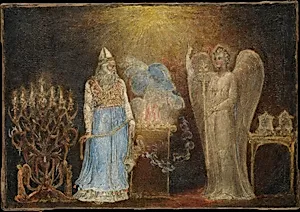
Blake's visual art during this period included watercolor series on biblical and literary subjects. Between 1805 and 1810, he created his extraordinary series of watercolors illustrating the Book of Revelation, including The Great Red Dragon and the Woman Clothed with the Sun, now housed at the Brooklyn Museum and National Gallery of Art in Washington. These powerful images of apocalyptic vision exemplify Blake's ability to visualize spiritual forces in dramatic, muscular forms.
Around 1819, Blake's fortunes improved slightly when he met John Linnell, a young artist who became an important patron and introduced Blake to a circle of young admirers. This group, calling themselves 'The Ancients,' included Samuel Palmer, Edward Calvert, and George Richmond. They revered Blake as a visionary master, visiting him regularly at his lodgings at 3 Fountain Court, off the Strand.
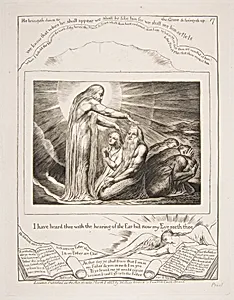
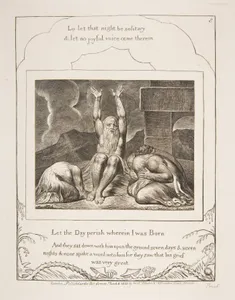
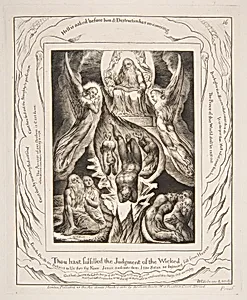
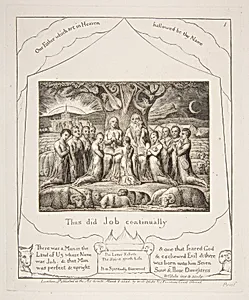
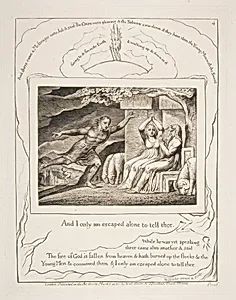
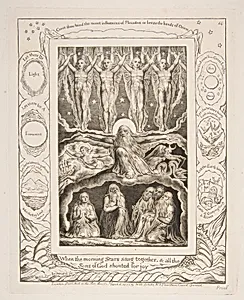
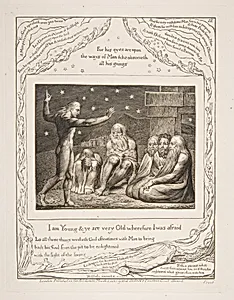
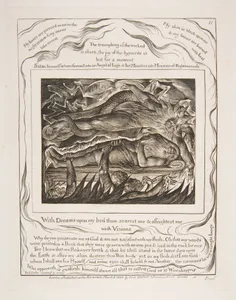
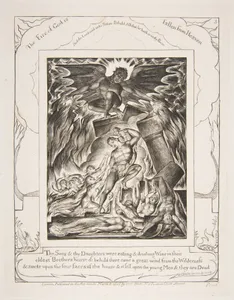
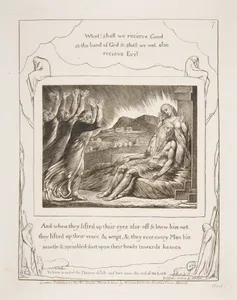
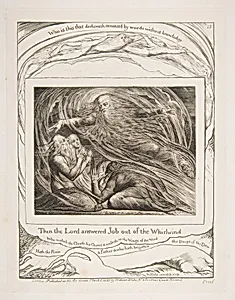
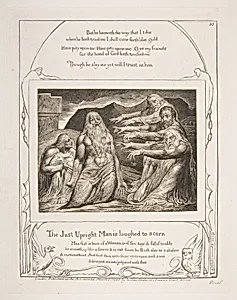
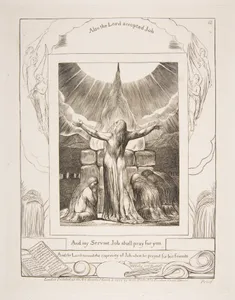
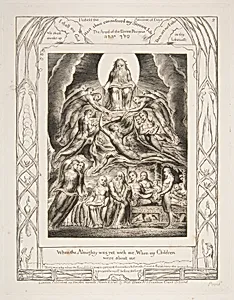
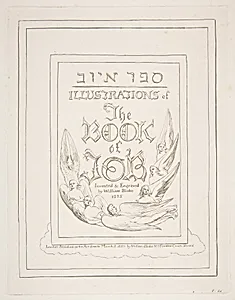
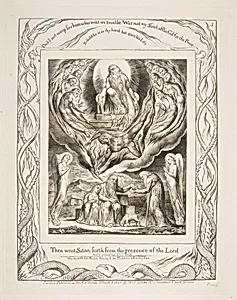
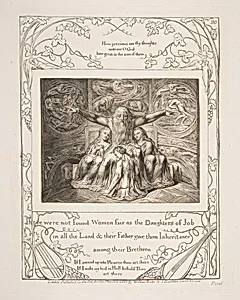
Through Linnell's patronage, Blake received his final major commissions: illustrations to the Book of Job (1823–1826) and Dante's Divine Comedy (begun 1824). The twenty-one engravings for the Book of Job represent the culmination of Blake's graphic art—a profound meditation on suffering, faith, and creative vision executed with supreme technical mastery. His linear style, deriving from his early training under Basire and study of medieval art, achieved perfect integration of text and image.
Blake began the Dante commission with enthusiasm, creating 102 watercolor illustrations, but death prevented him from completing more than seven engravings. These late Dante works show undiminished imaginative power, though Blake, who considered Dante's theology flawed, took liberties with his interpretations, using the commission to express his own spiritual vision.
On August 12, 1827, Blake died at his home in Fountain Court, working on his Dante series until the very end. According to his friend George Richmond, Blake 'died ... in a most glorious manner. He said He was going to that Country he had all His life wished to see & expressed Himself Happy, hoping for Salvation through Jesus Christ.' He was buried in an unmarked grave at Bunhill Fields. At the time of his death, he had sold fewer than thirty copies of Songs of Innocence and of Experience. Catherine Blake continued to print and sell his works until her death in 1831.
Artheon Research Team
Last updated: 2025-11-28
Biography length: ~1,142 words
Wikidata/Wikimedia Commons