
Ctrl K
1800–1900
C. G. Hawkhurst was a British designer active during the 1830s, a period when neoclassical revivals flourished in British architecture and interior decoration. Little is known about his early life or training, as historical records on the artist remain sparse, with no documented teachers, art schools, or family connections emerging from available sources. His sole surviving work in major collections exemplifies the era's fascination with ancient motifs, blending Etruscan and Pompeian influences into opulent room designs.
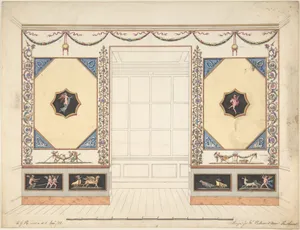
Hawkhurst's known masterpiece, *Design for a Room in the Etruscan or Pompeian style (Elevation)* (1833), is a meticulously rendered drawing in pen and black ink with watercolor and subtle touches of gold ink, measuring 9½ x 12⅜ inches. This elevation depicts an elegant interior wall scheme inspired by the rediscovered frescoes of Pompeii and Herculaneum, featuring mythological figures, garlands, and architectural niches against vibrant grounds—hallmarks of the Pompeian revival that swept Europe after 18th-century excavations. Hawkhurst worked in this ornamental tradition, popular among Regency and early Victorian tastemakers for evoking classical grandeur in domestic spaces, akin to designs by contemporaries like John Crace.
Today, Hawkhurst's obscurity underscores the challenges of documenting minor figures in 19th-century design, yet his preserved drawing at The Metropolitan Museum of Art—acquired as a gift from Harry G. Friedman in 1962—offers invaluable insight into period aesthetics._MET_DP804393.jpg) Classified under Drawings and Prints in the Ornament & Architecture category, it highlights the crossover between fine art and practical decoration, influencing later historicist movements. Though no other works surface in archives, Hawkhurst's contribution endures as a window into Britain's enduring romance with antiquity, reminding us how ephemeral many creative lives proved in the pre-photographic age.
All 1 artworks loaded