
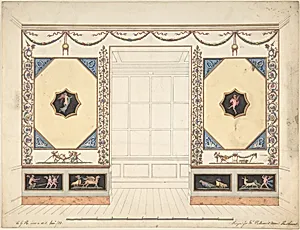
Design for a Room in the Etruscan or Pompeian style (Elevation)
1833
Medium
Pen and black ink, watercolor with touches of gold ink
Dimensions
sheet: 9 1/2 x 12 3/8 in. (24.1 x 31.4 cm)
Classification
Drawings|Ornament & Architecture
Department
Drawings and Prints
Museum
Metropolitan Museum of Art, New York, NY
Credit
Gift of Harry G. Friedman, 1962
Accession Number
62.635.216
Rights
Public Domain
Tags
Art Historical Context
Step into the opulent world of 19th-century interior design with C. G. Hawkhurst's *Design for a Room in Etruscan or Pompe style (Elevation)*, in 1833. This delicate elevation drawing presents a side view of a grand room adorned with motifs drawn from ancient Etruscan Pompeian art—think intricate frescoes, classical columns, and mythological scenes revived from the ruins of Pompeii and Herculaneum. Hawkhurst, a skilled and designer of the era, captures the Regency taste for neoclassical grandeur, blending archaeological accuracy with fanciful elegance for wealthy British patrons. Rendered in pen and black ink with vibrant watercolor washes and shimmering touches of gold ink, the work showcases masterful techniques that mimic the luminosity of ancient murals. The fine lines delineate architectural details like pediments and friezes, while gold accents evoke the lavish metallic embellishments of Roman villas. At 9 1/2 x 12 3/8 inches, this intimate sheet from the Metropolitan Museum of Art's Drawings and Prints department highlights the precision of ornamental drafting, a key practice in the period's pattern books and architectural folios. This piece reflects the 1830s cultural obsession with antiquity, fueled by excavations and publications that inspired a "Pompeian revival" in homes and public spaces. Donated by Harry G. Friedman in 1962, it offers visitors a window into how designers like Hawkhurst transformed dusty relics into living luxury.
About the Artist
C. G. Hawkhurst · 1800–1900
C. G. Hawkhurst was a British designer active during the 1830s, a period when neoclassical revivals flourished in British architecture and interior decoration. Little is known about his early life or training, as historical records on the artist remain sparse, with no documented teachers, art schools, or family connections emerging from available sources. His sole surviving work in major collectio...