Ctrl K
The C Painter stands as one of the most significant Attic black-figure vase painters of the Archaic period, active in Athens circa 575–550 BCE. His conventional name, assigned by the scholar John Beazley, derives from his pronounced “Corinthianising” style, which drew heavily on Corinthian vase-painting traditions while adapting them to Attic techniques and vessel shapes. Working primarily in the black-figure technique, he succeeded the Comast Group and favored older forms such as the lekanis, tripod kothon, and skyphos, yet he also introduced innovations like the Merrythought cup—the first Attic example without an offset lip—and produced innovative lekythoi with pronounced shoulders.
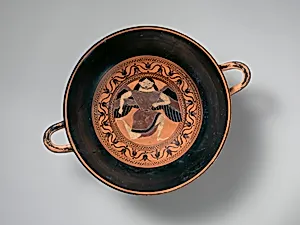
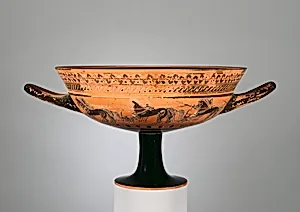
His artistic approach blended Corinthian precedents with distinctly Attic innovations. He frequently depicted duelling warriors, horsemen, symposiasts, and komasts, employing white paint added over the black slip for details rather than directly onto the clay. Mythological scenes appear in elongated friezes, echoing earlier painters like the Gorgon Painter and Kleitias, and feature powerful figures with somewhat enlarged heads. A hallmark of his work is the use of animal heads as shield devices. He excelled particularly as a painter of Siana cups, considered the earliest and finest exponent of that shape, and toward the end of his career his workshop began producing cups that anticipated the later lip-cup form.
Among his most notable surviving works is the lid of a lekanis now in Naples, which bears the earliest known depiction of the death of Astyanax. Another important piece is a Siana cup in Munich showing a squatting warrior—possibly Achilles awaiting Troilos—inside the bowl. A fragmentary inscription on one vase reading “…eiron epoie” (“…eiron made it”) suggests his actual name may have been Cheiron or Pheiron.
The C Painter’s influence extended through his workshop’s production of Siana cups and his synthesis of Corinthian and Attic elements, helping shape the trajectory of black-figure painting in Athens. His careful draftsmanship and distinctive iconographic choices made him a key figure in the transition toward more narrative complexity in Greek vase decoration. Two works attributed to him are held in the museum’s collection, offering visitors a direct encounter with this pioneering Archaic master.