
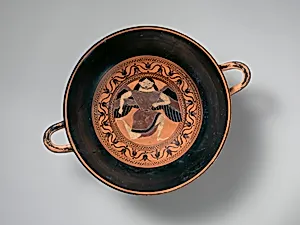
Terracotta kylix: Siana cup (drinking cup)
ca. 575 BCE
Medium
Terracotta
Dimensions
H. 5 1/8 in. (13 cm) diameter 9 5/8 in. (24.5 cm)
Classification
Vases
Culture & Period
Greek, Attic · Archaic
Department
Greek and Roman Art
Museum
Metropolitan Museum of Art, New York, NY
Credit
Purchase, 1901
Accession Number
01.8.6
Rights
Public Domain
Tags
Art Historical Context
This terracotta Siana cup, crafted around 575 BCE by the artist known as the C Painter, represents a fine example of Archaic Greek pottery from Attica. As a kylix, or two-handled drinking vessel, it was designed for use in symposia—the lively social gatherings central to ancient Athenian male culture. Its modest size and elegant shape made it both practical and visually appealing on the banquet table. The cup’s black-figure decoration, typical of the period, includes lively scenes of men, horses, shields, and the hero Achilles. These motifs reflect the Archaic interest in heroic mythology and martial themes drawn from epic poetry. The C Painter’s distinctive style shows careful attention to overlapping figures and dynamic poses, helping to advance narrative storytelling on pottery. Acquired by the Metropolitan Museum in 1901, this vessel highlights how everyday objects in ancient Greece carried rich cultural meaning, blending utility with artistic expression during a formative era of Greek art.
About the Artist
C Painter
The C Painter stands as one of the most significant Attic black-figure vase painters of the Archaic period, active in Athens circa 575–550 BCE. His conventional name, assigned by the scholar John Beazley, derives from his pronounced “Corinthianising” style, which drew heavily on Corinthian vase-painting traditions while adapting them to Attic techniques and vessel shapes. Working primarily in the ...