Ctrl K
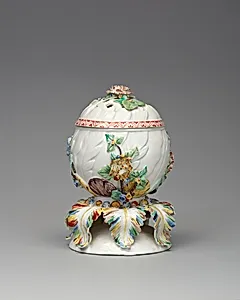
The Chantilly Factory produced celebrated French soft-paste porcelain from around 1725 to 1800 in Chantilly, Oise, under the patronage of Louis Henri de Bourbon, Prince de Condé, an avid collector of East Asian ceramics who established the works near his château after purchasing riverside outbuildings in 1730. The factory’s technical foundations were laid by Ciquaire Cirou, a painter who had trained at the Saint-Cloud manufactory and conducted experiments for a decade before receiving a 1735 royal privilege from Louis XV to manufacture porcelain “in imitation of the porcelain of Japan.” Cirou directed the enterprise until his death in 1751, guiding its most distinctive output.
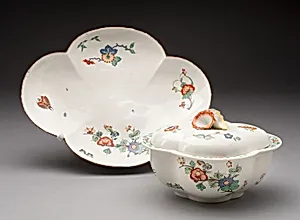
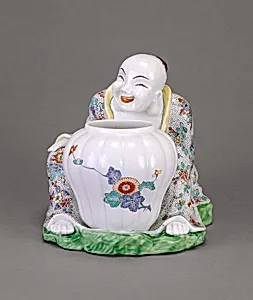
In its first period the factory specialized in Kakiemon-style wares that closely copied Japanese and Chinese models, employing an innovative opaque tin glaze over a yellowish body to create a milky-white ground for sparse enamel decoration in iron-red, blue-green, and gold. Table and tea services, small vases, and Oriental figures known as magots featured motifs such as dragons, quails, partridges, pomegranates, and the “Prince Henri” pattern derived from Meissen interpretations of Japanese “Red Dragon” designs. After the prince’s death in 1740 the factory continued independently, producing its most characteristic and highly prized pieces under Cirou’s leadership.
Subsequent decades brought challenges: potters departed for Vincennes (later Sèvres), which received royal monopolies that restricted Chantilly’s polychrome work, prompting a shift toward simpler underglaze-blue floral sprigs, scrolls, and occasional Sèvres-inspired forms. Production declined after 1760 amid competition from Sèvres at the luxury end and, later, English creamware; the factory changed owners several times, including a 1781 sale and acquisition in 1792 by the Englishman Christopher Potter, before closing around 1800.
Chantilly porcelain remains admired for its aristocratic refinement, technical ingenuity, and role as a bridge between Oriental sources and European Rococo taste. Pieces bearing the factory’s distinctive hunting-horn mark are held in major collections worldwide, and the wares’ desirability spawned numerous nineteenth-century imitations. The factory’s legacy endures as a key chapter in the history of French ceramics, illustrating both princely ambition and the evolving market for luxury porcelain.
All 3 artworks loaded