
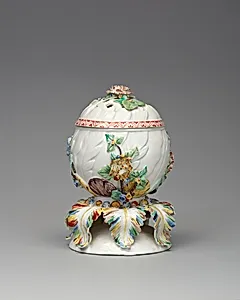
Potpourri Vase
c. 1745
Medium
Soft-paste porcelain and polychrome enamels
Dimensions
16.2 × 11.2 cm (6 3/8 × 4 3/8 in.)
Classification
chantilly
Department
Applied Arts of Europe
Museum
Art Institute of Chicago
Accession Number
251503
Rights
Public Domain
About this artwork
The design for this potpourri vase is unusual and exuberant, with a foliate pattern encircling the oval body and lively, brightly colored acanthus leaves at the base. This reflects the factory’s shift from Japanese Kakiemon and Chinoiserie motifs to Rococo decoration in the later 1740s.
Art Historical Context
This exquisite Potpourri Vase, made around 1745 at France’s Chantilly Factory captures the refined luxury of mid-18th-century decorative arts. Standing just over 16 centimeters tall, it was crafted from soft-paste porcelain and with vibrant polychrome enamels. Such vases held fragrant mixtures of dried flowers and spices, perfuming the elegant interiors of aristocratic homes during the Rococo era. The Chantilly Factory, established in the 1730s, became renowned for its high-quality soft-paste porcelain—a European innovation that produced a creamy, luminous body before true hard-paste formulas were widely mastered. This material lent itself beautifully to colorful enamel decoration, allowing artisans to create delicate, jewel-like surfaces that rivaled imported Asian wares while suiting French tastes. Objects like this potpourri vase blended utility with artistry, reflecting the period’s delight in sensory pleasure and exquisite craftsmanship. Today it offers visitors a tangible connection to the opulent daily life and technical ingenuity of 18th-century France, preserved in the Art Institute of Chicago’s collection of Applied Arts of Europe.
About the Artist
Chantilly Factory
The Chantilly Factory produced celebrated French soft-paste porcelain from around 1725 to 1800 in Chantilly, Oise, under the patronage of Louis Henri de Bourbon, Prince de Condé, an avid collector of East Asian ceramics who established the works near his château after purchasing riverside outbuildings in 1730. The factory’s technical foundations were laid by Ciquaire Cirou, a painter who had train...