Ctrl K
1872–1909
**Compagnia di Venezia e Murano: Reviving Ancient Glass Mastery**
The Compagnia di Venezia e Murano (C.V.M.), a pioneering Venetian glass firm, emerged from the vision of English archaeologist Austen Henry Layard, antiquarian William Drake, and lawyer Antonio Salviati, who founded it in 1866 in London as Salviati & C. Layard, drawing on his expertise in ancient artifacts, directed the company—renamed in 1872 as the Venice and Murano Glass and Mosaic Company Limited—to Murano, where it established furnaces and employed master glassblowers from families like the Segusos, who became partners in 1877. Operating until production ceased in 1909, C.V.M. transformed Murano's artisanal heritage by blending traditional blowing techniques with rigorous experimentation funded by British capital.
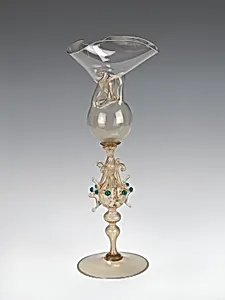
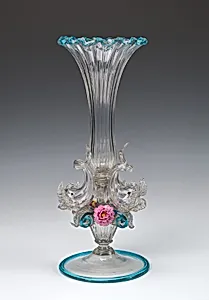
C.V.M. worked in the Murano glass tradition, excelling in the revival of long-lost Roman and pre-Roman methods. In 1872, artisan Vincenzo Moretti, guided by Layard and antiquarians Alessandro and Augusto Castellani, recreated murrine—complex mosaic canes unseen for nearly two millennia—alongside techniques like engraved cameo glass by Attilio Spaccarelli (1884), enameling taught by painter Giuseppe Devers, and specialties such as lattimo (milky glass), filigrana, avventurina, calcedonio, and ruby-red glass. Collaborators included engravers, goldsmiths, and designers like Elihu Vedder and Edward Burne-Jones, producing ornate blown vessels with gilding, hot-work applications, and optic molding, as seen in surviving beakers, chalices, compotes, and sea-horse vessels.
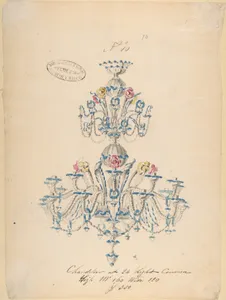
The firm's major works spanned functional goblets, chandeliers, and vases to grand mosaics adorning sites like Gonville and Caius College Chapel in Cambridge (1870), St. Paul's Within the Walls in Rome, Westminster Cathedral, and the Victoria and Albert Museum; a 1866 micromosaic portrait of Abraham Lincoln graces the U.S. Senate. C.V.M. dazzled at exhibitions, winning 13 prizes in Vienna (1873), showcasing murrine as the star of Paris (1878), and installing kilns at Chicago's World's Columbian Exposition (1893), while the Metropolitan Museum holds 23 exquisite watercolor design sheets for mirrors, chandeliers, and goblets (ca. 1850–80).
C.V.M.'s legacy endures through two generations of trained maestri— including Baroviers and Segusos—who spawned firms like Barovier & Toso and Seguso, perpetuating Murano's renaissance. Though production halted in 1909 under owner Tosolini amid commercial shifts, its fusion into Pauly & C. in 1919 sustained the flame of innovative Venetian glass, cementing C.V.M. as a bridge between antiquity and modernity. (378 words)
All 2 artworks loaded