Ctrl K
Occupations
The Darius Painter was an Apulian vase painter active in Magna Graecia between approximately 340 and 320 BC. He stands as the most eminent representative of the late “Ornate Style” in South Italian red-figure vase painting. His conventional name derives from his name vase, the monumental Darius Vase (or Darius Crater), a volute krater discovered in 1851 near Canosa di Puglia and now housed in the National Archaeological Museum in Naples. He worked in a large, factory-like workshop, probably located in Taranto (ancient Taras), and may have served as its owner or foreman. Many vases closely resembling his hand are attributed to this workshop rather than to the painter himself.
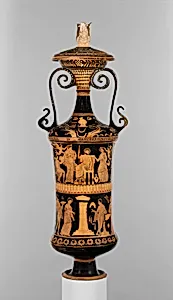
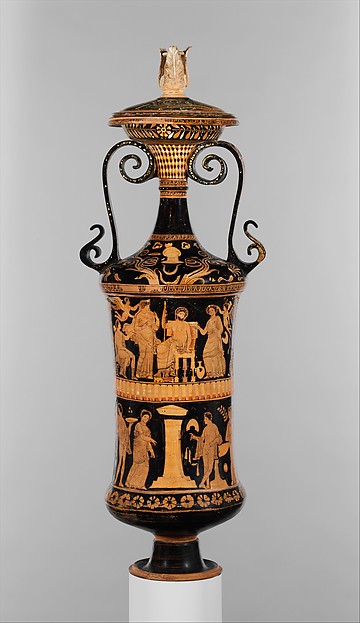
His artistic style is characterized by elaborate compositions that fill every available surface on large vessels such as volute kraters, amphorae, and loutrophoroi, often arranged in two or three registers separated by rich ornamental friezes. He frequently employed inscriptions not only to label figures but also thematically, functioning almost as titles. The painter excelled at rendering faces in three-quarter profile and is regarded as the first to fully exploit the possibilities of large-format vase painting. His subjects ranged widely: theatrical scenes drawn especially from Euripides, mythological narratives (some known only from his vases), wedding and Dionysiac motifs, and occasional historical themes. Sepulchral naiskos scenes appear rarely and usually on the reverse of vessels.
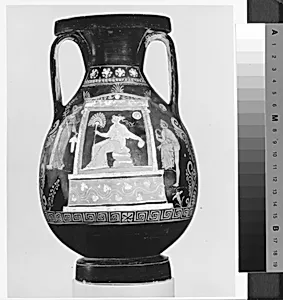
Among his most celebrated works is the Darius Vase itself, which depicts a Persian court scene with King Darius III receiving counsel, flanked by personifications of Greek gods above and a tax-collection scene below, alongside combat imagery on the neck. Other notable pieces include a Phrixos krater and various amphorae and pelikes featuring mythological or genre subjects. Stylistically, he succeeded the Varrese Painter and his circle while surpassing their achievements; contemporaries included the Perrone and Phrixos Painters. His most important follower was the Underworld Painter.
The Darius Painter is widely considered the last major figure in Apulian vase painting. After his time, the quality of the tradition declined sharply in the third century BC. Arthur Dale Trendall, a leading authority on South Italian ceramics, described him as the most important painter of mythological scenes in the entire development of South Italian vase painting. His innovative use of scale, inscription, and narrative complexity left a lasting mark on the ornate phase of the medium.
Wikidata (CC0); Getty ULAN (ODC-By)
All 2 artworks loaded