
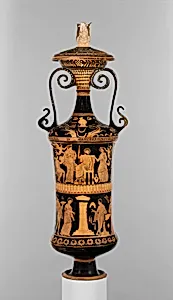
Terracotta loutrophoros (ceremonial vase for water)
ca. 340–330 BCE
Medium
Terracotta
Dimensions
H. 36 5/8 in. (93 cm)
Classification
Vases
Culture & Period
Greek, South Italian, Apulian · Late Classical
Department
Greek and Roman Art
Museum
Metropolitan Museum of Art, New York, NY
Credit
Rogers Fund, 1911
Accession Number
11.210.3a, b
Rights
Public Domain
Tags
Art Historical Context
This striking terracotta loutrophoros, standing nearly a meter tall, was crafted around 340–330 BCE in Apulia, a region of South Italy settled by Greeks. Created by the Darius Painter, one of the most accomplished vase painters of the Late Classical period, the vessel served a ceremonial role—carrying water for ritual baths or funerary offerings. Its impressive scale and refined execution reflect the high status such objects held in both domestic and tomb settings. The Darius Painter’s distinctive style is evident in the vase’s elaborate figural decoration, which draws on rich Greek mythology. Scenes featuring Aphrodite, Adonis, Persephone, Zeus, and figures with lyres suggest a narrative exploring themes of love, death, and rebirth. These compositions, typical of Apulian red-figure technique, use added white and yellow pigments to highlight details, creating a lively, almost sculptural effect on the curved surface. As a product of the Greek colonies in South Italy, this loutrophoros illustrates how Athenian artistic traditions merged with local tastes, resulting in vases that were both functional and powerfully expressive. Today in the Metropolitan Museum’s collection, it offers visitors a vivid window into ancient beliefs about life’s cycles and the enduring power of myth.
About the Artist
Darius Painter
The Darius Painter was an Apulian vase painter active in Magna Graecia between approximately 340 and 320 BC. He stands as the most eminent representative of the late “Ornate Style” in South Italian red-figure vase painting. His conventional name derives from his name vase, the monumental Darius Vase (or Darius Crater), a volute krater discovered in 1851 near Canosa di Puglia and now housed in the ...