Ctrl K

1810–1879
Movements
Occupations
Honoré-Victorin Daumier (1808-1879) was a prolific French printmaker, caricaturist, painter, and sculptor whose works offered incisive commentary on the social and political life of 19th-century France. Known as the 'Michelangelo of Caricature,' Daumier produced over 4,000 lithographs, 500 paintings, 1,000 drawings, and 100 sculptures during his lifetime. His biting political satire led to his imprisonment in 1832 for depicting King Louis-Philippe as the gluttonous giant Gargantua, yet this only enhanced his reputation as France's most fearless social commentator. Daumier's artistic genius lay in his ability to combine technical mastery with profound social consciousness. His lithographs for journals like La Caricature and Le Charivari lampooned corrupt politicians, pompous lawyers, greedy bourgeoisie, and hypocritical clergy, while his paintings revealed a tender sympathy for the working poor. Though his paintings were largely unrecognized during his lifetime, they prefigured Impressionism and influenced artists from Degas to Picasso. Poet Charles Baudelaire called him 'one of the most important men, not only in caricature, but also in modern art.' Daumier's legacy extends far beyond his era. His innovative use of satire, monumental stylization, and fearless political critique established him as a pioneer of artistic social commentary. His work demonstrated that art could serve as both entertainment and powerful political weapon, inspiring generations of artists to use their talents to expose injustice and champion the oppressed. Despite dying in poverty and near-blindness, Daumier left an indelible mark on modern art and the tradition of visual satire.
Honoré-Victorin Daumier was born on February 26, 1808, in Marseille, France, to Jean-Baptiste Louis Daumier, a glazier and aspiring poet, and Cécile Catherine Philippe. His father's literary ambitions led the family to relocate to Paris in 1816, seeking artistic success but finding only poverty. When Daumier was about twelve years old, his father suffered a mental breakdown, forcing the young boy to leave school and work as an errand boy for a court bailiff. This early exposure to the legal system would later fuel his scathing satirical series on lawyers and judges.
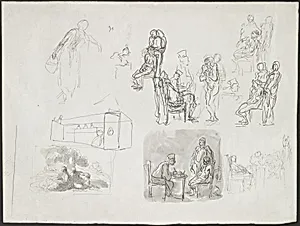
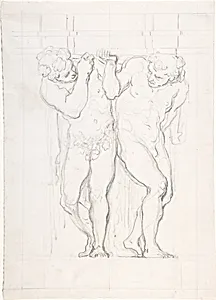
Despite his family's financial struggles, Daumier's passion for drawing led him to pursue artistic training. In 1822, he became a protégé of Alexandre Lenoir, a friend of his father and founder of the Musée des Monuments Français. Lenoir, a former student of Jacques-Louis David, introduced Daumier to classical art and sculpture, instilling a lasting appreciation for monumental form that would characterize his work. In 1823, Daumier enrolled at the Académie Suisse, an instructor-less studio that offered affordable access to live models. There he befriended fellow students including Philippe Auguste Jeanron and Auguste Raffet, while spending his free hours studying Old Master paintings at the Louvre, particularly works by Rubens, Rembrandt, Titian, and Goya. Around this time, he also learned lithographic techniques from Charles Ramelet and found work with Zéphirin Belliard, producing miscellaneous illustrations, advertisements, and street scenes that honed his technical skills.
The July Revolution of 1830 transformed Daumier from a struggling illustrator into France's most audacious political satirist. Publisher Charles Philipon recruited him to create lithographs for his new satirical journals La Caricature and Le Charivari, which targeted the newly installed King Louis-Philippe and his government. Together, Daumier and Philipon developed the pear (la poire) as a satirical emblem of the July Monarchy, exploiting the resemblance between the king's face and the fruit to create a powerful symbol of corruption and gluttony. Daumier's caricatures portrayed ministers as masks to expose their hypocrisy, depicted the king as a bloated parasite feeding on the impoverished masses, and mercilessly lampooned the monarchy, aristocracy, clergy, judiciary, and bourgeoisie.
Daumier's most notorious work from this period, Gargantua (1831), showed an enormous Louis-Philippe seated on a throne while starving citizens fed their last coins into his insatiable maw. The lithograph referenced the king's extravagant 18-million-franc salary—37 times more than Napoleon's and 150 times the American president's compensation. In February 1832, Daumier was convicted of 'inciting to hatred and contempt of the government and insulting the king' and sentenced to six months in Sainte-Pélagie prison with a 500-franc fine. Far from silencing him, the imprisonment made Daumier a folk hero and enhanced his popularity. During this period, sculptor Auguste Préault encouraged Daumier to create three-dimensional clay portrait busts of politicians, which he used as studies for his lithographs. These brutally satirical sculptures, particularly his series Célébrités du Juste Milieu (1832-1835), displayed an almost sculptural approach to caricature that led Balzac to say Daumier had 'a bit of Michelangelo under his skin.' However, the September Laws of 1835 severely restricted press freedom, forcing Daumier to abandon direct political commentary.
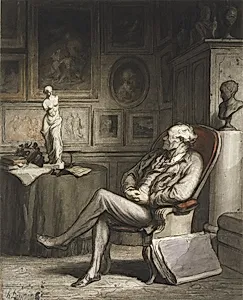
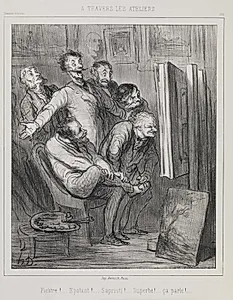
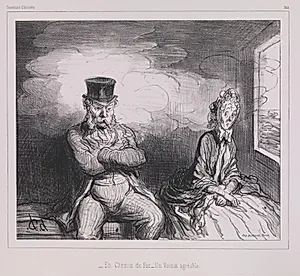
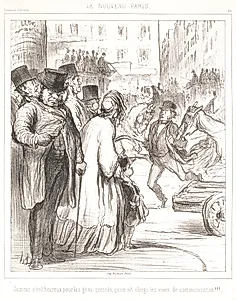
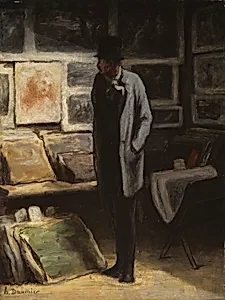
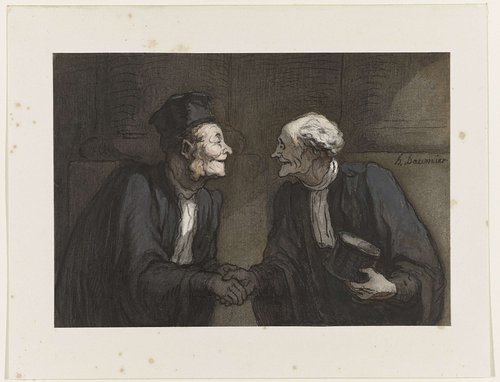
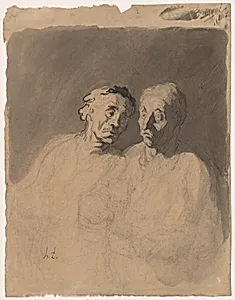
After censorship laws curtailed political satire, Daumier shifted his focus to social commentary, creating gentler but equally incisive critiques of bourgeois life and Parisian society. He developed a gallery of recurring character types and archetypal figures that appeared throughout his work: pompous lawyers in his series Les Gens de Justice (39 albums lampooning the corrupt legal system), the confidence artist Robert Macaire (an unrepentant swindler always launching fraudulent enterprises), and various representations of bourgeois excess, with pear-shaped bodies symbolizing capitalist greed. His lithographs documented every aspect of Parisian life—theater audiences, art collectors, doctors, musicians, street vendors, and the daily indignities of urban existence.
During this period, Daumier refined his distinctive artistic style, characterized by bold, energetic lines, dramatic contrasts of light and shadow, and monumental simplification of form. His innovative use of satire combined comic genius with serious social critique, making complex political and social issues accessible to a broad public. Despite producing thousands of lithographs that appeared regularly in Le Charivari, Daumier earned modest income and lived in relative poverty. Nevertheless, he gained the admiration and friendship of leading artists including Jean-Baptiste-Camille Corot, Gustave Courbet, Eugène Delacroix, Jean-François Millet, and Théodore Rousseau. Delacroix thought so highly of Daumier's drawings that he copied them for study, while his artistic peers increasingly recognized that his lithographs transcended mere journalism to achieve genuine artistic significance.
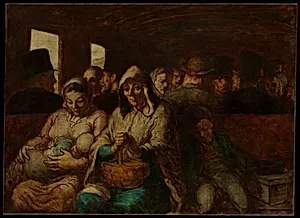
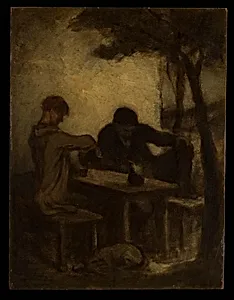
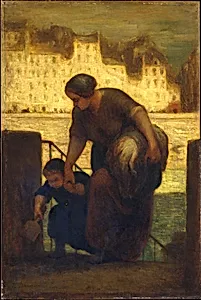
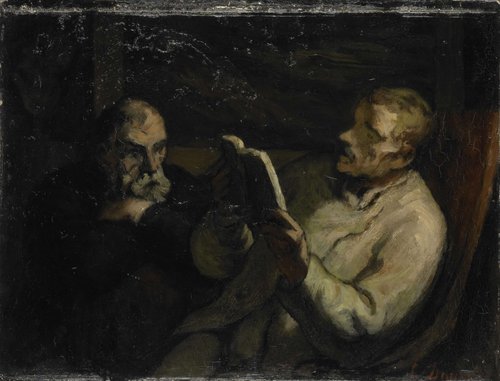
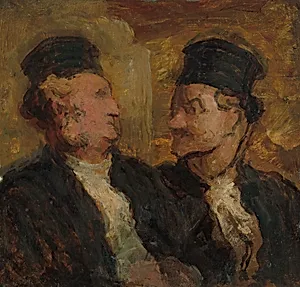
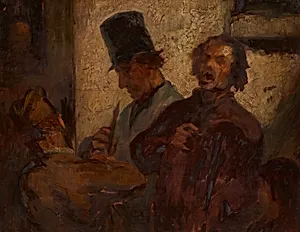
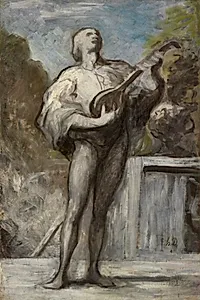
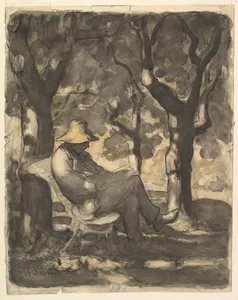
While Daumier continued producing lithographs throughout his career, he increasingly devoted himself to painting, creating works that combined realist observation with profound humanitarian sympathy. Unlike Gustave Courbet and other realists who proclaimed their ideology, Daumier never formally identified as a realist, and his paintings retained a romantic emotional intensity absent from Courbet's detached objectivity. His canvases depicted scenes of modern urban life—railway carriages, laundresses, emigrants, street performers—rendered with loose, expressive brushwork that anticipated Impressionist techniques.
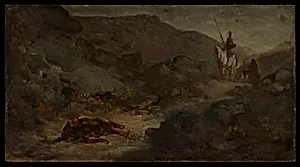
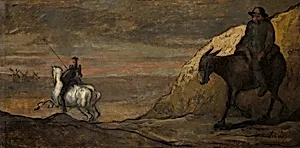
His most celebrated painting, The Third-Class Carriage (c. 1862-1864), exemplifies his mature style and social vision. The work portrays working-class passengers crowded into a third-class railway car during the industrialization of Paris. Rather than employing satire or melodrama, Daumier captures the quiet dignity of the poor—a family absorbed in thought, isolated yet united in their shared experience of hardship. The painting demonstrates Daumier's remarkable ability to convey profound social commentary through subtle observation of everyday moments. Other significant paintings from this period include The Laundress, The Uprising, and numerous depictions of Don Quixote, a character with whom Daumier increasingly identified as an idealistic fighter against injustice. His friend Corot particularly admired these paintings and attempted to promote them, though the art establishment and public largely ignored Daumier's work as a painter during his lifetime.
In 1865, Daumier moved to Valmondois, a small village outside Paris, where he lived in a cottage provided by his friend Corot. His eyesight, which had troubled him for years, continued to deteriorate, and he struggled with poverty despite his prodigious output. He persisted in creating lithographs and paintings, often returning to the theme of Don Quixote, the tragic idealist tilting at windmills. The Franco-Prussian War and fall of the Second Empire in 1870 marked the end of the political era Daumier had chronicled for four decades. As his vision failed and his health declined, his productivity diminished but never ceased entirely.
In 1877, the French Third Republic granted Daumier a modest pension in recognition of his contributions to French culture. The following year, a major exhibition of his paintings was organized in Paris, finally bringing critical attention to his work as a painter rather than merely a lithographer. Poet and critic Charles Baudelaire had earlier proclaimed Daumier 'one of the most important men, not only in caricature, but also in modern art,' and this late exhibition confirmed that assessment. On February 10, 1879, Daumier died following a paralytic stroke, leaving behind many unfinished paintings. Though he died in poverty and obscurity, his influence would grow exponentially in subsequent decades, with artists from Degas to Picasso acknowledging their debt to his innovations. Today he is recognized as one of the great French artists of the 19th century, a pioneer of both social realism and modern visual satire whose work remains powerfully relevant to contemporary discussions of art, politics, and social justice.
Artheon Research Team
Last updated: 2025-11-28
Biography length: ~1,147 words
Wikidata/Wikimedia Commons