Ctrl K
1861–1941
Ernst Moritz Geyger (1861–1941) was born on November 9, 1861, in Rixdorf (now Berlin-Neukölln), into a family rooted in education; his father, Gustav Ernst Geyger, served as rector of a Berlin community school, and his mother was Albertina Lisetta Ida Brückner, with siblings including Elfriede, known as Lisa. At age sixteen, he began training in the painting class at Berlin's Art School in 1877, then studied from 1878 to 1883 at the Prussian Academy of Arts under professors Paul Meyerheim (specializing in animal painting), Paul Thumann, Otto Knille, and Max Michael. Self-taught in sculpture starting in 1886, he honed his skills through travels to Florence, Paris, and Berlin, bypassing formal sculptural instruction.
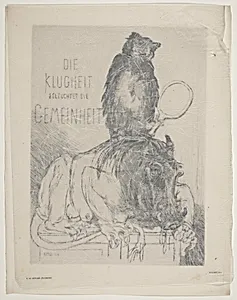
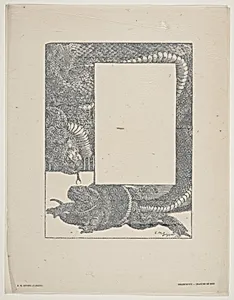
A versatile artist aligned with the Berlin Sculptors' School, Geyger excelled in hyper-realistic animal paintings, satirical etchings, and dynamic bronze sculptures emphasizing anatomy and pathos. Early acclaim came for works like *Viehfütterung* (Cattle Feeding, 1885), which won a gold medal for its Dutch-inspired realism, and *Die Weisheit* (Wisdom, 1887), a life-size marabou stork painted in a day. His etchings, such as the parodic *Große Affendisputation* mocking Darwinism, showcased grotesque wit. Sculpturally, *Der Dornauszieher* (Thorn-Puller, 1891) and his iconic *Bogenschütze* (Archer, 1902)—with bronze copies in Dresden's Elbe embankment, Hannover's Trammplatz, Potsdam's Sanssouci Park, and Copenhagen—captured tense, muscular motion, acquired by Kaiser Wilhelm II. Other landmarks include the Bear Cub Fountain in Wrocław (1902) and the Fairy Tale Fountain in Berlin (1915).
Geyger's career spanned freelance work, a brief professorship at Dresden's Academy in 1893, and a graphics master class at Berlin Academy from 1918 to 1927; he settled near Florence in 1895, maintaining studios there and in Berlin. He won a 1903 defamation suit against Max Klinger and, in later years, saw works like *Bull* (1901, 1938 oil version) purchased by Adolf Hitler, earning a 1936 pension and 1941 Goethe Medal shortly before his death in Marignolle. His multifaceted legacy endures in museums like the Los Angeles County Museum of Art and Carnegie Museum of Art, with a Berlin street named in his honor, celebrating his shift from painter to sculptor of enduring public monuments.
All 2 artworks loaded