
Ctrl K
Francesco del Tuppo (c. 1443/44–1501) was a prominent Italian artist, printer, and publisher active in Naples during the late 15th century. Working in the vibrant artistic milieu of Renaissance southern Italy, he specialized in woodcut illustrations that brought literary texts to life with intricate, narrative-driven imagery. Del Tuppo's editions, such as those featuring fables and moral tales, showcased his mastery of the woodcut medium, blending Gothic detail with emerging Renaissance naturalism. His prints were widely influential, circulating designs that captured everyday scenes, mythological figures, and fantastical elements with a lively, decorative flair.
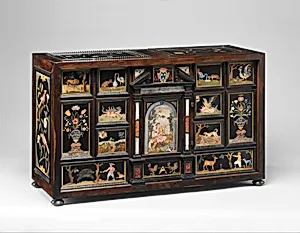
In the early 17th century, Florence's Galleria dei Lavori—a renowned workshop specializing in luxury furniture and decorative arts—drew directly from del Tuppo's woodcuts to create one of its masterpieces: the Barberini Cabinet (c. 1606–1623). Crafted from oak and poplar with exquisite marquetry inlays, the cabinet reproduces over 100 of del Tuppo's illustrations, transforming printed imagery into three-dimensional opulence. This monumental piece, now housed in The Metropolitan Museum of Art, exemplifies the Galleria's expertise in intarsia and pietra dura techniques, rooted in the Florentine tradition of grand ducal patronage. The workshop operated under Medici influence, continuing the legacy of Mannerist opulence seen in spaces like the Studiolo of Francesco I in the Palazzo Vecchio, though no direct teacher or mentor for the Galleria's artisans is documented in surviving records.
The Barberini Cabinet stands as a testament to del Tuppo's enduring impact, bridging printmaking and furniture design across a century. Its densely packed panels—depicting ships, animals, hunters, and allegorical scenes—reflect the encyclopedic curiosity of the Baroque era, while honoring del Tuppo's narrative precision. Though biographical details of del Tuppo's training remain sparse, his role as a publisher suggests immersion in Neapolitan workshops influenced by northern European print traditions. The Galleria dei Lavori, emblematic of Florence's collaborative craft guilds, elevated such sources into objects of princely prestige, influencing later cabinetry across Europe. Today, this fusion endures in museum collections, highlighting how Renaissance prints fueled the decorative arts' golden age.
(Word count: 348)
No artworks found for this artist