Ctrl K
1875–1910
Occupations
Furuya Kōrin (古谷紅麟, 1875–1910), born in the village of Kaizu in Shiga Prefecture near Kyoto, emerged as a pivotal figure in Japan's Meiji-era arts scene. He pursued rigorous training under several influential mentors, beginning with the Shijō-style painter Suzuki Mannen (1868–1893), followed by studies with the Western-style painter Asai Chū (1856–1907), and most significantly, the Rinpa revivalist Kamisaka Sekka (1866–1942). In 1897, his prowess was recognized when he won first prize in painting at the second Shinkō Bijutsu Tenrankai (Exhibition of New and Old Art). By 1905, Kōrin joined the faculty of the Kyoto Municipal School of Arts and Crafts, rising to assistant professor shortly before his untimely death at age 35.
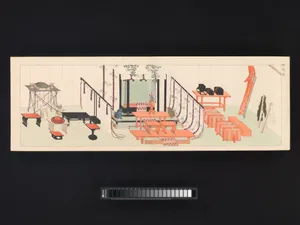
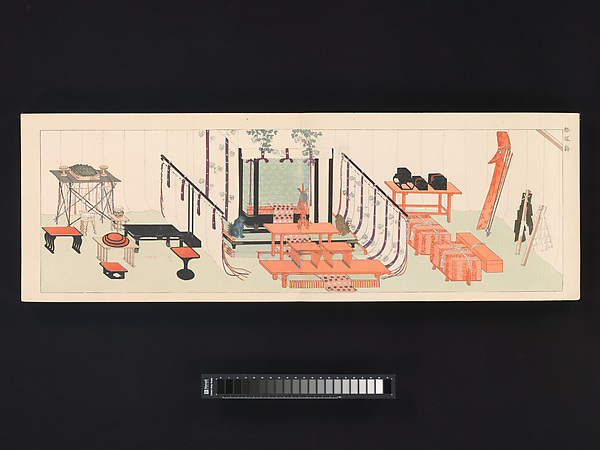
Kōrin worked firmly in the Rinpa school tradition, adopting his pseudonym from the eighteenth-century master Ogata Kōrin (1658–1716), whom he styled himself the "Kōrin of the modern age." His designs blended nostalgic reverence for classical Japanese motifs—waves, flowers, pines, bamboo, and clouds—with abstract, layered patterns suited for textiles and crafts, reflecting Meiji Japan's tension between tradition and Western-influenced modernization. A master of woodblock-printed *gafu* (picture albums) and *ehon* (picture books), he produced lavish *orihon* (concertina-bound) volumes, including *Sixteen Illustrations of Ancient Ceremonial Displays* (1903), depicting opulent Imperial Court interiors for rituals like tea ceremonies, weddings, and poetry gatherings, complete with silver-heightened plates of armor, bonsai, and furnishings. Other key works encompassed pattern books on flowers and plants (1905), pine trees (1905), bamboo (1907), and *Kōrin Patterns (Kōrin moyō)* (1907), a two-volume kimono design compendium featuring iconic wave motifs and skiffs.
As co-editor of the influential *Shin-Bijutsukai* (New Oceans of Art, 1901–1906) with Kamisaka Sekka, published by Unsōdō, Kōrin championed avant-garde decorative designs—translucent leaf forms, oozing plant frames, and dissolving canopies—in over 36 issues, drawing contributions from leading artists. His final painting, *Shoreline at Dusk* (1910), exemplifies his ethereal style. Kōrin's legacy endures in major collections like the Metropolitan Museum of Art, British Museum, and Rijksmuseum, where his innovative fusion of Rinpa abstraction and modern utility continues to inspire designers bridging East and West.
Wikidata (CC0)
All 1 artworks loaded