Ctrl K
1741–1825
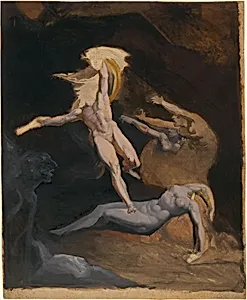
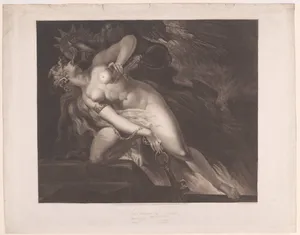
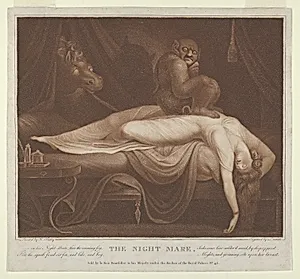
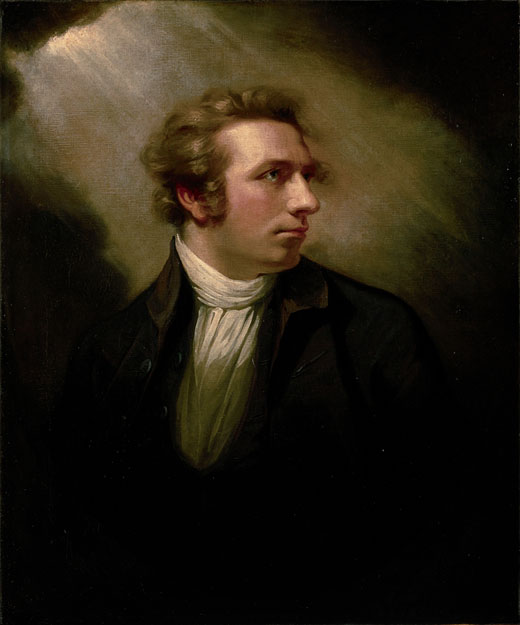
Henry Fuseli (1741-1825), born Johann Heinrich Füssli in Zürich, was a Swiss-British painter whose visionary works exploring dreams, nightmares, and psychological terror made him one of the most original figures of the Romantic movement. His art bridged Neoclassical discipline with Romantic emotionalism, creating images of supernatural intensity that would influence artists from William Blake to the Surrealists. The second of 18 children born to a portrait painter, Fuseli was denied artistic training by his father and instead prepared for the ministry, taking holy orders in 1761. His classical education at the Caroline College of Zürich introduced him to Shakespeare and Milton—authors whose works would inspire him throughout his career. After helping expose a corrupt magistrate forced him to leave Switzerland, he settled in London in 1764, where Joshua Reynolds encouraged him to pursue painting. An eight-year residency in Rome (1770-1778) devoted to studying Michelangelo transformed Fuseli's approach. He absorbed the master's muscular figures and dramatic poses while developing his signature style of exaggerated emotion and supernatural subject matter. Upon returning to London, he exhibited 'The Nightmare' (1781) at the Royal Academy—a shocking image of a sleeping woman visited by demonic forces that became an immediate sensation and established his reputation. Fuseli was elected to the Royal Academy in 1790 and served as Professor of Painting (1799-1805, 1810-1825) and Keeper of the Schools (1804-1825). Though not noted as a colorist, he was a master of chiaroscuro, creating stark contrasts between light and shadow that intensified his scenes' psychological drama. His belief that 'detail tends to destroy terror' led him to prioritize emotional impact over descriptive accuracy. After his death, Fuseli was buried in St. Paul's Cathedral beside Reynolds—a testament to his standing. Though neglected for nearly a century, the Expressionists and Surrealists rediscovered him as a kindred spirit, recognizing his exploration of dreams and the unconscious as remarkably prescient.
Born Johann Heinrich Füssli in Zürich, the second of 18 children to portrait painter Johann Caspar Füssli, who paradoxically opposed his son's artistic ambitions.
Fuseli received classical education at the Caroline College of Zürich under critics J.J. Breitinger and J.J. Bodmer, who introduced him to Milton and Shakespeare—foundational influences on his artistic vision.
Ordained as a Zwinglian minister in 1761, he soon abandoned the priesthood after helping expose a corrupt magistrate forced him to leave Switzerland.
Moving to London in 1764, he worked as a translator until Joshua Reynolds, impressed by his drawings, encouraged him to pursue painting and study in Italy.
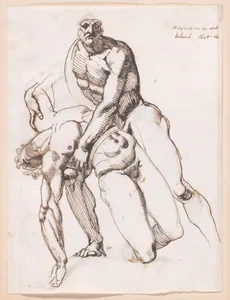
Fuseli spent eight years in Rome immersed in the study of Michelangelo, whose muscular figures, dramatic poses, and elevated style he sought to emulate for the rest of his life.
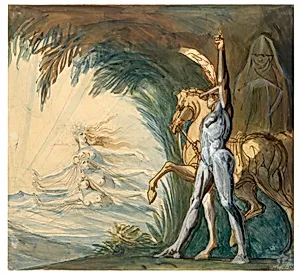
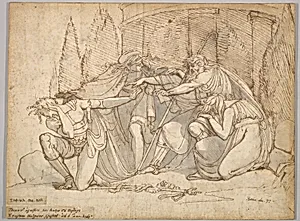
He absorbed Mannerist techniques while developing his distinctive approach to supernatural and literary subjects, connecting with the German Sturm und Drang movement.
Goethe, a key figure of Sturm und Drang, admired and collected Fuseli's drawings, seeing him as the visual embodiment of the movement's emphasis on subjective expression over Enlightenment rationalism.
By 1773, Fuseli had established a reputation in Rome, laying the groundwork for his later career in London.
Returning to London in 1779, Fuseli exhibited at the Royal Academy and achieved sensational success with 'The Nightmare' (1781), an erotic and haunting image that shocked and fascinated viewers.
He was elected Associate of the Royal Academy in 1788 and full Academician in 1790, with his Diploma Work depicting Thor Battering the Midgard Serpent from Nordic mythology.
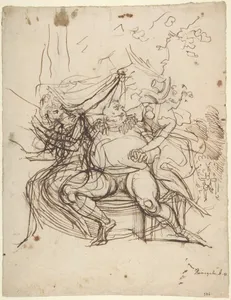
In 1788, he married Sophia Rawlins, who became the subject of numerous intimate drawings and paintings. Their relationship inspired some of his most personal works.
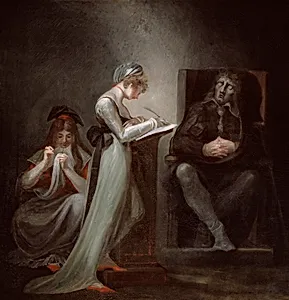
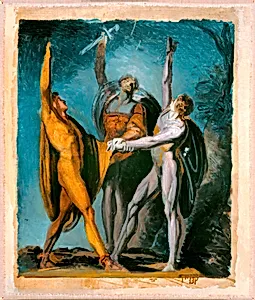
This period produced his major Shakespearean and Miltonic paintings, establishing him as the leading painter of literary and supernatural subjects in Britain.
Fuseli served as Professor of Painting at the Royal Academy Schools (1799-1805, 1810-1825), becoming a popular teacher and respected figure in British art.
His ambitious Milton Gallery project (begun 1791) aimed to create a comprehensive series of paintings illustrating Paradise Lost, though it achieved limited commercial success.
From 1804, he served as Keeper of the Royal Academy Schools until his death, shaping the education of younger artists.
He died in London on April 16, 1825, and was buried in St. Paul's Cathedral beside Reynolds—an honor reflecting his standing in British art despite the controversial nature of his work.