Ctrl K

1848–1903
Occupations
Paul Gauguin (1848-1903) was a French Post-Impressionist painter whose bold experiments with color, form, and subject matter made him one of the most influential figures in the transition from 19th-century art to modernism. His rejection of European civilization for the perceived authenticity of 'primitive' cultures established an archetype of artistic exile that continues to resonate. Gauguin's path to art was unconventional. After a childhood partly spent in Peru and service in the merchant marine, he worked successfully as a Parisian stockbroker while painting as an amateur. Following the 1882 financial crash, he abandoned his Danish wife and five children to pursue art full-time, a decision that shadowed his reputation but liberated his vision. Training informally under Camille Pissarro, Gauguin exhibited with the Impressionists but soon developed a distinctive approach he called 'Synthetism'—the synthesis of observed forms with symbolic and emotional content. Works like 'Vision After the Sermon' (1888) employed bold outlines, flat color areas, and simplified forms derived from Japanese prints, medieval stained glass, and folk art. His famous nine-week collaboration with Vincent van Gogh in Arles (1888) ended dramatically but demonstrated his central role in Post-Impressionist experimentation. Frustrated by lack of recognition and seeking 'primitive' spiritual authenticity, Gauguin sailed to Tahiti in 1891, beginning a decade of work that produced his most celebrated paintings. In Tahiti and later the Marquesas Islands, Gauguin created works combining vivid tropical color with Symbolist philosophy, exploring questions of existence, spirituality, and humanity's relationship with nature. His masterpiece 'Where Do We Come From? What Are We? Where Are We Going?' (1897) synthesized these concerns in a monumental meditation on life's stages. Gauguin died in poverty and obscurity in 1903, but posthumous exhibitions at the Salon d'Automne (1903, 1906) profoundly influenced the French avant-garde. His liberation of color from naturalistic representation and his legitimization of 'primitive' aesthetics shaped Fauvism, Expressionism, and Picasso's development of Cubism.
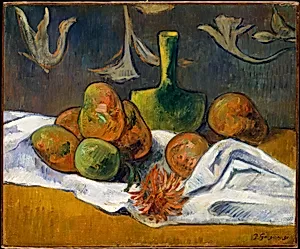
Gauguin began painting as an amateur while working as a successful Parisian stockbroker, his interest kindled by his guardian Gustave Arosa's collection of Romantic and Realist paintings.
He met Camille Pissarro through Arosa and became an informal pupil, collecting Impressionist works and painting landscapes and still lifes in his spare time.
By 1879, Pissarro had invited Gauguin to exhibit with the Impressionists. The 1882 financial crash prompted his decision to abandon his career and family for full-time artistic pursuit.
His early work showed strong Impressionist influence, but he was already seeking something beyond optical naturalism—what he would later call the 'inner life' beneath appearances.
Seeking escape from Paris and affordable living, Gauguin settled in the artists' colony at Pont-Aven in Brittany, attracted by the region's Celtic culture and traditional way of life.
Here he developed 'Synthetism,' synthesizing observed forms with imaginative and emotional content. 'Vision After the Sermon' (1888) marked a breakthrough, employing bold outlines, flat color areas, and simplified forms.
'The Yellow Christ' (1889) exemplified Cloisonnism—areas of pure color separated by heavy black outlines, abandoning classical perspective and subtle gradation.
His nine-week collaboration with Vincent van Gogh in Arles (October-December 1888) ended with Van Gogh's mental breakdown, but the period was crucial for both artists' development.
Frustrated by lack of recognition and 'everything that is artificial and conventional' in European civilization, Gauguin sailed to Tahiti in 1891 seeking spiritual authenticity.
His first major Tahitian work, 'Ia Orana Maria' (Hail Mary), combined Christian iconography with Polynesian figures and tropical landscape, establishing his synthetic approach to cultural imagery.
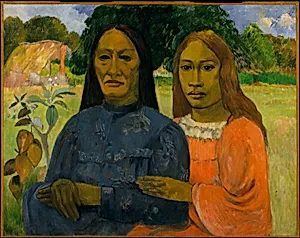
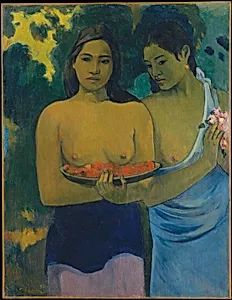
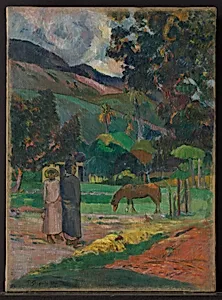
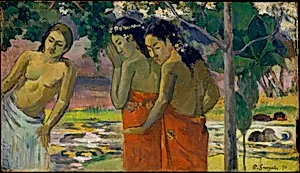
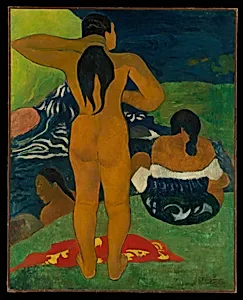
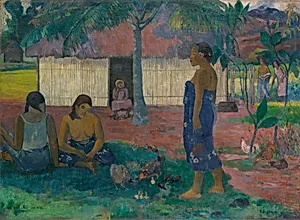
Works from this period feature vivid, non-naturalistic colors, flat decorative patterning, and subjects exploring Tahitian daily life, spirituality, and mythology.
Financial difficulties forced his return to France in 1893, where he exhibited his Tahitian work with mixed reception but growing influence among younger artists.
Gauguin returned to Tahiti in 1895, never to see Europe again. Declining health from syphilis, poverty, and conflict with colonial authorities marked these years.
In 1897, devastated by news of his daughter's death and his own deteriorating condition, he painted his philosophical masterpiece 'Where Do We Come From? What Are We? Where Are We Going?' before attempting suicide.
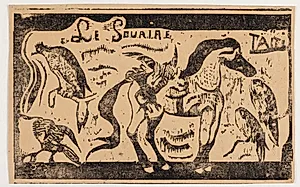
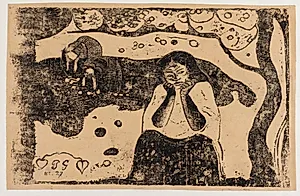
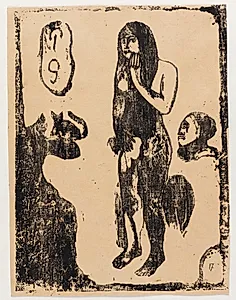
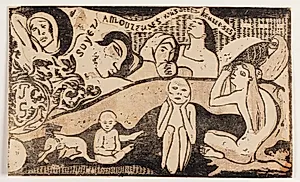
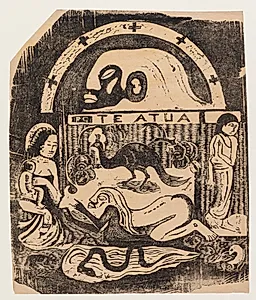
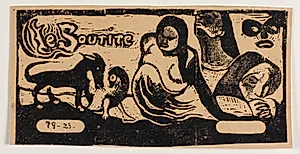
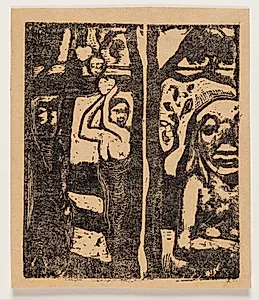
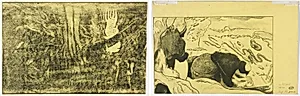
He moved to the remote Marquesas Islands in 1901, continuing to paint, write, and create woodcuts despite failing health.
Gauguin died in Atuona on May 8, 1903. Within months, major retrospective exhibitions in Paris established him as a central figure in modern art.
Wikidata/Wikimedia Commons