Ctrl K

1593–1652
Georges de La Tour (1593–1652) was a French Baroque painter born in Vic-sur-Seille in the Duchy of Lorraine. Baptism records confirm he was the son of baker Jean de La Tour and Sybille Molian, one of seven children. In 1617 he married Diane Le Nerf, from a minor noble family, and by 1620 he had established his studio in her hometown of Lunéville, where he remained for most of his career. He achieved notable success during his lifetime, receiving the title “Painter to the King” in 1638 and working for patrons including Henry II, Duke of Lorraine, as well as the local bourgeoisie.
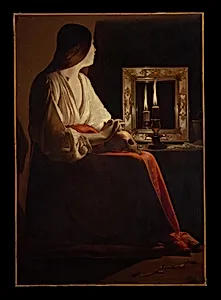
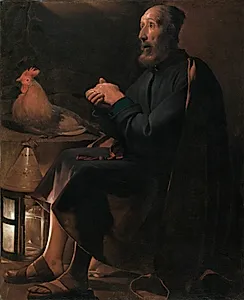
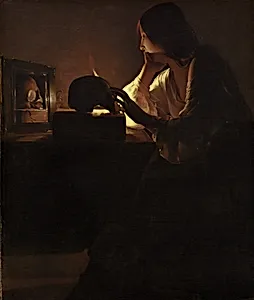
La Tour worked within the Baroque tradition at the confluence of Nordic, Italian, and French cultures, as a contemporary of Jacques Callot and the Le Nain brothers. His early paintings reflect the dramatic chiaroscuro and naturalism of Caravaggio, likely transmitted through the Dutch Caravaggisti of the Utrecht School and artists such as Hendrick Terbrugghen. He may have trained briefly under Jacques Bellange in Nancy, though their styles differ markedly. Over time his work evolved toward greater simplicity and stillness, characterized by geometric compositions, simplified forms, and scenes lit dramatically by a single candle or torch—effects he developed further than his predecessors.
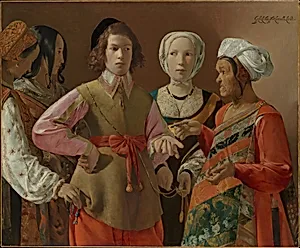
He painted both religious subjects and genre scenes, often producing multiple versions of the same composition. Among his best-known works are *The Fortune Teller* (Metropolitan Museum of Art), *Joseph the Carpenter* (1642, Louvre), *Magdalene at a Mirror*, and *The Card Sharp with the Ace of Diamonds*. His son Étienne (1621–1692) trained under him and assisted in the studio. La Tour and much of his family perished in an epidemic in Lunéville in 1652.
Although celebrated in his own time, La Tour’s work was largely forgotten after his death. It was rediscovered in the early twentieth century by German art historian Hermann Voss, leading to a reevaluation that established him as one of the most original successors of Caravaggio and a master of light and contemplative atmosphere. His paintings continue to inspire writers and artists for their profound realism and spiritual intensity.