
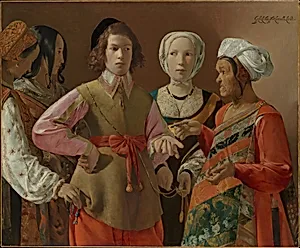
The Fortune-Teller
probably 1630s
Medium
Oil on canvas
Dimensions
40 1/8 x 48 5/8 in. (101.9 x 123.5 cm)
Classification
Paintings
Department
European Paintings
Museum
Metropolitan Museum of Art, New York, NY
Credit
Rogers Fund, 1960
Accession Number
60.30
Rights
Public Domain
Tags
Art Historical Context
Georges de La Tour'sThe Fortune Teller*, likely painted in the 1630s, is a captivating oil-on-canvas work from the French Baroque era, measuring 40 1/8 x 48 5/8 inches. Housed in the Metropolitan Museum of Art's European Paintings department (acquired through the Rogers Fund in 0), it showcases La Tour's mastery ofoscuro—the dramatic interplay of light and shadow defines his style. As a leading artist of the Lorraine school, La Tour drew inspiration from Caravaggio, using subdued lighting to heighten emotional tension and realism in everyday scenes. This painting exemplifies 17th-century genre painting, a popular European tradition depicting ordinary life with subtle moral undertones. Featuring men and women in close interaction—evoking themes of chance, deception, or human folly—the composition draws viewers into an intimate, nocturnal moment illuminated by a single light source, a signature La Tour technique. Oil on canvas allowed for the rich textures and glowing highlights that make his figures emerge vividly from the darkness. A gem of Baroque artistry, *The Fortune Teller* invites reflection on fortune's unpredictability, blending historical realism with timeless intrigue for museum visitors today.
About the Artist
Georges de La Tour · 1593–1652
Georges de La Tour (1593–1652) was a French Baroque painter born in Vic-sur-Seille in the Duchy of Lorraine. Baptism records confirm he was the son of baker Jean de La Tour and Sybille Molian, one of seven children. In 1617 he married Diane Le Nerf, from a minor noble family, and by 1620 he had established his studio in her hometown of Lunéville, where he remained for most of his career. He achiev...