Ctrl K
1809–1873
**Giovanni Maria Benzoni (1809–1873)** was an Italian neoclassical sculptor renowned for his elegant marble figures that captured the refined tastes of 19th-century collectors on the Grand Tour. Born on August 28, 1809, in the small mountain village of Songavazzo near Bergamo to a family of modest means, Benzoni began his working life as a shepherd and then as an apprentice carpenter in his uncle’s workshop at Riva di Solto on Lake Iseo. There he first demonstrated his talent for carving religious figures in wood.
His early promise attracted the attention of local patrons, particularly Count Luigi Tadini of Crema, who became his lifelong protector and sponsor. Tadini arranged for Benzoni’s formal training at the Academy of Fine Arts in Lovere and, around 1828, financed his move to Rome. In the Eternal City, Benzoni worked in the studio of Giuseppe Fabris and attended the Accademia di San Luca. He quickly absorbed the neoclassical language of Antonio Canova, earning the nickname “il novello Canova” (the new Canova) for his graceful, idealized figures.
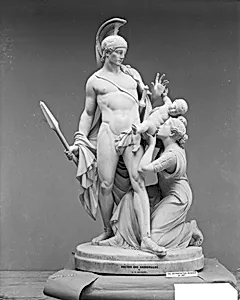
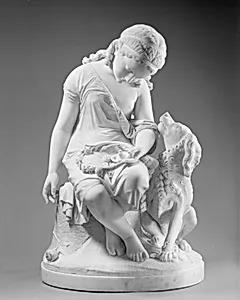
Benzoni established a large and highly organized workshop in Rome—first in Via Sant’Isidoro, later moving to larger premises on Via del Babuino and Piazza del Popolo—where he employed up to fifty assistants to meet the demand for replicas of his most popular subjects. His output included mythological and allegorical groups such as *Cupid and Psyche* (c. 1845–46), the celebrated *Veiled Rebecca* (1863), *Innocence Defended by Loyalty*, and the dramatic late work *Flight from Pompeii* (1868). He also created important funerary monuments, among them the tomb of Cardinal Angelo Mai in the Basilica of Sant’Anastasia al Palatino and a bust of his patron Count Tadini.
Benzoni married into a noble Roman family and had six children; he remained based in Rome for the rest of his life while maintaining ties to his native Bergamo. After his death on April 28, 1873, his neoclassical style fell out of favor in the newly unified Italy, but his works have enjoyed renewed appreciation in recent decades. Examples of his sculpture are held in museums across Europe, the United States, Australia, and India, testifying to the international reach he achieved in his lifetime.