Ctrl K
Giovanni Paolo Panini (1691–1765) was born in Piacenza, Italy, where he received his early artistic training under the painters Giuseppe Natali and Andrea Galluzzi, as well as the renowned stage designer Francesco Galli-Bibiena. In 1711, at age 20, he moved to Rome, the eternal city that would define his career, and studied drawing under Benedetto Luti while establishing himself as a fresco decorator and architect. Admitted to the Accademia di San Luca in 1719, Panini quickly gained commissions for grand decorative schemes, including the Villa Patrizi (1719–1725) and Palazzo de Carolis (1720), blending architectural precision with illusionistic perspective honed from his quadratura background.
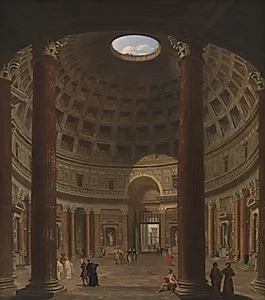
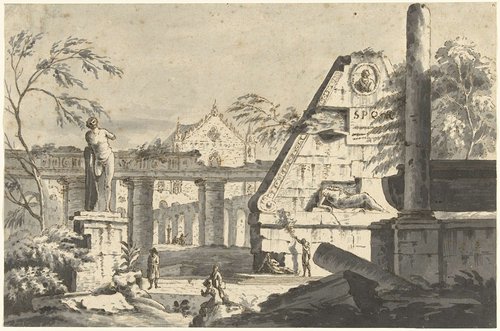
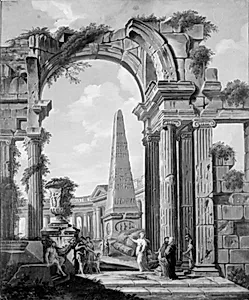
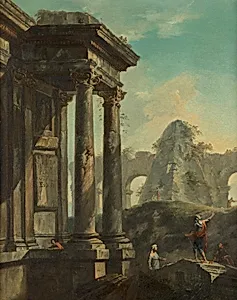
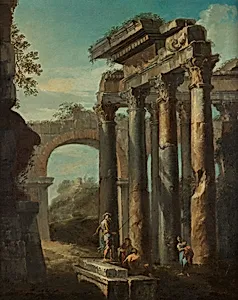
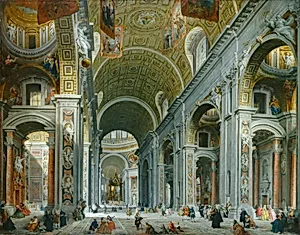
Panini emerged as one of the foremost vedutisti, or view painters, of the Baroque era, specializing in capricci—fantastical compositions of Roman ruins and monuments that evoked the city's ancient grandeur amid imaginative decay. His style married meticulous topography with poetic license, influencing the transition toward Romanticism through tender, nostalgic depictions of antiquity. Iconic works include *Interior of the Pantheon* (c. 1734, National Gallery of Art), *The Nave of St. Peter's Basilica* (1735, Norton Simon Museum), and his masterpieces *Picture Gallery with Views of Modern Rome* (1757, Museum of Fine Arts, Boston) and *Gallery of Views of Ancient Rome* (1758, Louvre), which ingeniously display dozens of Roman landmarks within illusory galleries. He also captured festive scenes like *Musical Feast Given by the Cardinal de La Rochefoucauld* (1747, Louvre) and religious subjects such as *Saint Paul Preaching in Athens* (1734).
In 1724, Panini married Miss Gossert and fathered two sons: Giuseppe, an architect and archaeologist, and Francesco, a painter who emulated his father's style. As professor of perspective at the French Academy in Rome and prince of the Accademia di San Luca (1754), he mentored talents like Hubert Robert, Antonio Joli, and Charles-Louis Clérisseau, while inspiring vedutisti such as Canaletto and Bernardo Bellotto. His innovative use of perspective even birthed the "Panini Projection" for panoramas. Panini's oeuvre, housed in institutions from the Louvre to the Met, endures as a vivid testament to Rome's layered history, bridging Baroque splendor with neoclassical reverence.