
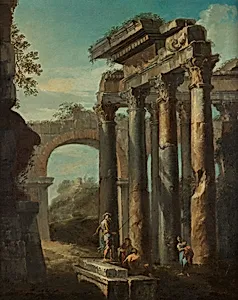
Römische Ruinenlandschaft
1730/1770
Medium
Öl auf Leinwand
Dimensions
47,5 × 38 cm
Classification
Gemälde
Department
Belvedere Collection
Museum
Belvedere
Credit
Belvedere, Vienna
Accession Number
SLM 33
Rights
Public Domain
Art Historical Context
Giovanni Paolo Pannini, a of 18th-century vedute (topographical views), captures the timeless allure of ancient ruins in *Römische Ruinenchaft* (Roman Ruins Landscape), an oil on canvas from around 1730–1770. This intimate 47.5 × 38 cm painting, housed in Vienna's Belvedere Collection, Pannini's skill in blending architectural precision with atmospheric drama, evoking the grandeur of imperial Rome amid its weathered remnants. Created during the height of the Grand Tour era when European aristocrats flocked to Italy for cultural enlightenment, Pannini's works served as cherished souvenirs and scholarly records. He often populated his scenes with tiny figures—pilgrims, artists, or tourists—to emphasize human scale against colossal arches, columns, and temples like the Colosseum or Pantheon fragments. This piece reflects the Rococo fascination with picturesque decay, romanticizing antiquity as a symbol of lost glory and inspiring neoclassical revival. Pannini's technique shines in his meticulous rendering of stone textures and light play, using oil's rich luminosity to heighten the ruins' melancholy poetry. As a professor at the Accademia di San Luca and painter to the Papal court, his compositions influenced generations, making this gem a window into Enlightenment-era reverence for classical heritage.
About the Artist
Giovanni Paolo Pannini
Giovanni Paolo Panini (1691–1765) was born in Piacenza, Italy, where he received his early artistic training under the painters Giuseppe Natali and Andrea Galluzzi, as well as the renowned stage designer Francesco Galli-Bibiena. In 1711, at age 20, he moved to Rome, the eternal city that would define his career, and studied drawing under Benedetto Luti while establishing himself as a fresco decora...